If you play Mega Millions even occasionally, it helps to know what the smaller prizes actually pay — and how often they happen. Matching one, two, or three numbers can turn a $2 ticket into $2, $4, $10, or $200 in a matter of minutes, and those “small wins” change how you should think about whether a ticket is worth buying, whether to use Megaplier, and how to handle taxes and claims. This article lays out the current standard prize amounts for the low tiers of Mega Millions, the exact odds behind them, how state rules and the Megaplier option change payouts, practical expected-value (EV) math that isolates the contribution of 1–3 number matches, and clear, step-by-step claiming and tax tips so you can treat small wins strategically instead of dismissing them.
Key Takeaways
You’ll get:
– a compact quick-answer summary of what one, two, and three correct numbers pay;
– plain-language odds and everyday comparisons that make the numbers relatable;
– a prize table and two realistic draw examples (including a Megaplier example);
– concrete EV calculations showing how much 1–3 correct numbers add to a ticket’s expected return; and
– straightforward guidance on claiming small prizes, taxes, and when it makes sense to reinvest a small win.
Quick answer: what 1, 2, and 3 matches pay (at a glance)
– Match Mega Ball only (no white balls): $2.
– Match 1 white ball + Mega Ball: $4.
– Match 2 white balls + Mega Ball: $10.
– Match 3 white balls (Mega Ball not required): $10.
– Match 3 white balls + Mega Ball: $200.
Megaplier: if you add the Megaplier option (usually $1 extra), non-jackpot prizes are multiplied by the Megaplier number drawn that night (commonly 2x, 3x, 4x, or 5x). That means the $2, $4, and $10 tiers above can become $4, $8, $20 or more — including the $200 turning to $400, $600, $800 or $1,000 — but you pay extra to add that potential. Note: these are the standard base payouts for Mega Millions prize tiers; some states apply small variations to certain low-tier payments or claim/retail rules. Verify current prize amounts and Megaplier pricing with your state lottery before you buy.
How Mega Millions prizes are set — fixed versus parimutuel, and what Megaplier does
Mega Millions separates prize tiers into two basic types: fixed-dollar tiers and pari‑mutuel (shared) tiers.
- Fixed-dollar tiers: these pay the same fixed amount every time. For Mega Millions, most lower-tier prizes are fixed. The common fixed tiers include winnings such as $2, $4, $10, $200 and the $1,000,000 second prize (matching all five white balls). Because these are fixed, you know in advance what you’ll receive if your ticket hits that tier.
- Pari‑mutuel tiers: the jackpot is the main pari‑mutuel prize. Its size changes based on ticket sales and the annuity/cash choice for the winner. If multiple tickets win the jackpot, winners split the prize according to rules. Some exceptional non-jackpot prizes in certain states or special promotions can be pari‑mutuel, but the main non-jackpot tiers for Mega Millions are normally fixed.
Megaplier multiplies non-jackpot prizes
– How it works: Megaplier is an add-on (often $1) you can buy when you purchase a Mega Millions play. On Megaplier nights, a separate drawing selects a multiplier value — typically 2x, 3x, 4x, or 5x. Any non-jackpot prize on a Megaplier-eligible ticket is multiplied by that value. For example, a $10 tier becomes $20 if the Megaplier is 2x, or $50 if it’s 5x.
- What’s multiplied: Megaplier applies to all non-jackpot prizes that your state allows to be multiplied. That routinely includes the $1,000,000 prize (so that prize can become $2M, $3M, $4M, or $5M for Megaplier tickets), along with the smaller fixed prizes such as $2, $4, $10, $200 and so on.
Why small-tier payouts sometimes differ across states
– Administrative choices: lotteries are run state-by-state, so some states set slightly different rules for small claims or special promotions. A handful of states may treat a particular low tier as pari‑mutuel or apply different fixed amounts in rare cases.
- Retailer cash limits: states also decide the maximum prize a retailer can pay in cash. This affects where you can redeem wins immediately; large prizes usually require visiting a lottery office.
- Sales taxes or additional state withholding: states set tax and withholding rules differently (more below), so your net payout after taxes may differ by state even if the published prize is the same.
In short: the low-tier prizes you see listed as $2, $4, $10, and $200 are the standard base payouts. Megaplier can multiply those amounts when you pay for the option, while state rules may affect how (and where) you receive your cash. Always confirm the specific payouts and claim rules with your state lottery at purchase.
Ready to turn an idea into practical income?
Odds of matching 1, 2, and 3 numbers — plain-language and math
Mega Millions draws 5 white balls from 70 and 1 gold “Mega Ball” from 25. Every unique combination of 5 white numbers and 1 Mega Ball is one possible winning ticket. The total number of possible combinations is 302,575,350 (that’s C(70,5) × 25).
To translate that into odds:
– If you match three white balls and the Mega Ball (3 + MB), your chance in a single play is roughly 1 in 14,547.
– If you match three white balls but not the Mega Ball (3 only), your chance is roughly 1 in 606.
– If you match two white balls plus the Mega Ball (2 + MB), your chance is roughly 1 in 693.
– If you match one white ball plus the Mega Ball (1 + MB), your chance is roughly 1 in 89.
– If you match the Mega Ball only (no white balls), the chance is roughly 1 in 37.
What those numbers mean in everyday language
– 1 in 37 (Mega Ball only): fairly common — expect that on average one ticket in about every 37 will win the $2 prize.
– 1 in 89 (1 + MB): still common enough that casual players can expect this occasionally — about one prize in every 89 tickets.
– 1 in 693 (2 + MB): uncommon but not rare — one in several hundred tickets.
– 1 in 606 (3 only): rarer than the 2 + MB tier in some senses, but comparable — often you’ll see one of these across many thousands of tickets.
– 1 in 14,547 (3 + MB): a small prize that feels meaningful ($200) but still much less frequent — it’s good to recognize it’s still a far more realistic outcome than the jackpot, but happens only a handful of times per million tickets.
Quick everyday comparisons:
– The 1-in-37 chance is comparable to flipping a fair coin and getting heads five times in a row (which is 1 in 32) — so the $2 prize is relatively common.
– The 1-in-14,547 chance is far rarer: imagine picking one specific person out of a mid-sized town — that’s the order of magnitude for a $200 hit.
Prize table and two real examples
Below is a simple layout of the current standard Mega Millions outcomes for the low tiers. These are the typical base prize amounts; if you add Megaplier they are multiplied when a Megaplier number is drawn. Verify the exact amounts for your state at purchase.
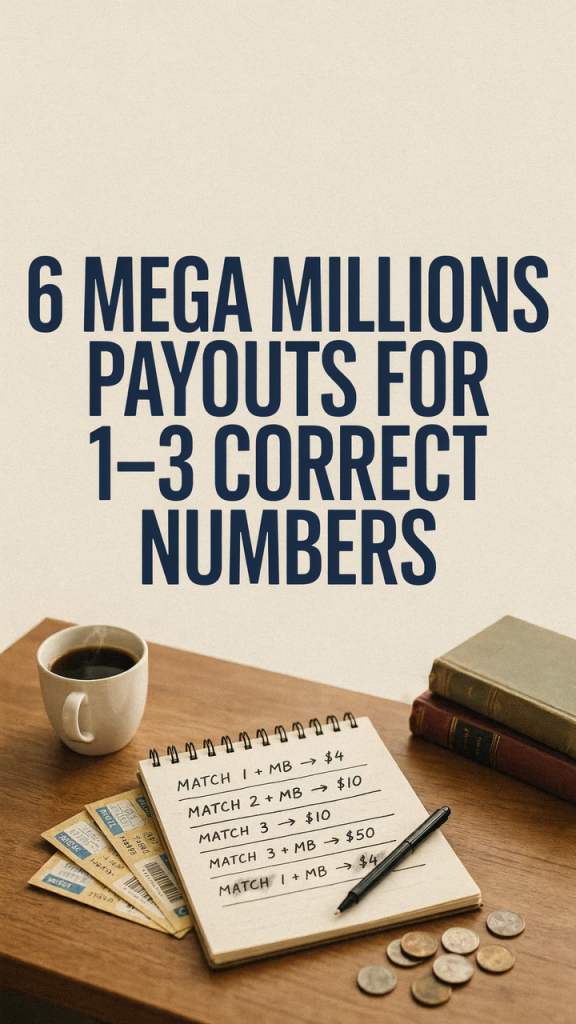
Prize table (standard base payouts)
– Match Mega Ball only: $2
– Match 1 white + Mega Ball: $4
– Match 2 whites + Mega Ball: $10
– Match 3 whites (no Mega Ball): $10
– Match 3 whites + Mega Ball: $200
With Megaplier (example multipliers)
– If Megaplier = 2x: $2 → $4; $4 → $8; $10 → $20; $200 → $400
– If Megaplier = 3x: $2 → $6; $4 → $12; $10 → $30; $200 → $600
– If Megaplier = 4x or 5x: multiply the base payouts accordingly
Two realistic draw scenarios
- Typical small-win night (no Megaplier chosen)
You buy a $2 ticket. The draw lands and you match the Mega Ball only. You hold a $2 prize. Odds-wise this happened with about 1-in-37 probability for that ticket. At many retailers you can cash that $2 immediately. If you happen to match 1 + MB instead, you’d get $4. These small wins are frequent enough that they may offset part of the cost of occasional play over time, but they do not make a ticket profitable on average.
- Megaplier example (Megaplier purchased for $1, multiplier drawn = 3x)
You buy a $3 play ($2 play + $1 Megaplier). You match 3 white balls plus the Mega Ball, a base $200 win. Because Megaplier was 3x, your prize becomes $600. You would receive the $600 (less any taxes or withholdings). This shows how Megaplier can turn a solid small prize into a more meaningful payout — but it costs you $1 extra and the multiplier is not guaranteed.
Expected value and what small matches contribute
Expected value (EV) is a way to measure what a ticket is worth on average, before taxes, by combining the probability of each outcome with its payout. EV does not predict what will happen to you personally on any one ticket; it tells you what, on average, each ticket returns if you could buy a very large number of tickets under identical conditions.
We’ll isolate the contribution of the common small tiers (the outcomes tied to matching 1–3 numbers and the Mega Ball-only tier) to show how much those tiers add to a single ticket’s EV. We’ll use the payout amounts listed earlier and the approximate probabilities described above.
Step-by-step EV calculation for small tiers (per $2 play, no Megaplier)
1) Compute probabilities (approximate):
– Mega Ball only: 1 in 36.63 ≈ 0.02730
– 1 + MB: 1 in 89.45 ≈ 0.01118
– 2 + MB: 1 in 693 ≈ 0.001442
– 3 only: 1 in 606 ≈ 0.001650
– 3 + MB: 1 in 14,547 ≈ 0.000068706
- Multiply each probability by its base payout:
– MB only: 0.02730 × $2 = $0.0546
– 1 + MB: 0.01118 × $4 = $0.0447
– 2 + MB: 0.001442 × $10 = $0.0144
– 3 only: 0.001650 × $10 = $0.0165
– 3 + MB: 0.000068706 × $200 = $0.0137
- Sum the contributions:
Total EV from these small tiers ≈ $0.144 per $2 ticket.
Interpretation
– Those low-tier matches together contribute roughly $0.14 of expected return per $2 ticket. That’s about 7.2% of the ticket price back from these small prizes on average.
– The rest of the ticket’s EV comes from larger non-jackpot tiers (like the $1,000,000 second prize) and the jackpot’s expected contribution (often heavily diluted by its huge odds). In most realistic jackpot scenarios the total EV still falls well below ticket cost.
Two mini-scenarios to see how Megaplier changes things
Scenario A — No Megaplier (baseline above)
– EV contribution from small tiers: ≈ $0.144
– Ticket cost: $2
– Small-tier EV as a percentage of ticket price: ≈ 7.2%
Scenario B — Megaplier purchased for $1; assume a 3x multiplier is drawn (illustrative single-night case)
– Multiply each prize by 3 and recompute expected contributions:
– MB only: 0.02730 × $6 = $0.1638
– 1 + MB: 0.01118 × $12 = $0.1342
– 2 + MB: 0.001442 × $30 = $0.0433
– 3 only: 0.001650 × $30 = $0.0495
– 3 + MB: 0.000068706 × $600 = $0.0412
– Total EV from small tiers with 3x Megaplier ≈ $0.432 per play.
– Net to you: you paid $1 extra to add Megaplier, so the marginal EV change for small tiers = $0.432 − $0.144 = +$0.288 from the prizes but −$1.00 extra cost = −$0.712 net on average (for that single-play model).
Key takeaway
– Even if a strong multiplier is drawn, because it costs money to buy the option, adding Megaplier usually lowers your net expected value unless you factor in the chance of multiplying larger prizes in ways that change your overall EV calculation. Using Megaplier is attractive when you value the chance of a larger non-jackpot payout for entertainment value, but it’s rarely a mathematically profitable buy on expected-value grounds alone.
State differences, claiming, and timing: practical steps
States run their own lotteries, so here’s a practical approach for handling small wins no matter where you are:
- Know the local cash limit for retailers
– Many states let licensed retailers pay out small prizes in cash on the spot; common retailer limits are up to $599 or $600, but this varies. If your prize is below your state’s retailer limit, you can usually hand the ticket to a store clerk and get cash immediately.
- For larger prizes, visit the lottery office
– Prizes above the retailer limit require a lottery claim form at a lottery office. For amounts like $200 or $1,000, verify whether your retailer can pay or you must visit a regional office.
- Check claim deadlines
– Lottery prizes do expire. Standard claim windows are often 180 days to one year from the draw, depending on state. Put the date in your phone if you win.
- Sign your ticket and keep copies
– Immediately sign and date the back of any winning ticket to establish ownership. Photograph both sides and store the physical ticket somewhere safe until you can claim.
- Consider anonymity and lump sum options
– Some states allow winners to remain anonymous; others require public disclosure for certain prize sizes. This matters mostly for larger wins, but it’s good to know your state’s rules in advance.
- Small prize redemption steps (practical how‑to)
– If your prize is at or below the retail limit: bring the signed ticket to a participating retailer, present ID if asked, and get cash.
– If the prize exceeds that limit or the retailer won’t pay: go to the lottery’s regional office, bring the signed ticket, a completed claim form, and valid ID. Call ahead to confirm business hours and required documents.
Taxes and reporting for small wins — what to expect
Taxes on lottery winnings depend on federal rules and state tax laws. Here’s a practical summary and steps to follow.
Federal basics
– Report all gambling winnings: the IRS expects you to report all gambling income on your tax return, no matter how small. That includes lottery prizes.
– Withholding: for larger lottery prizes, federal withholding can apply. For many lotteries, the IRS withholding threshold and rate for certain prizes triggers when a prize exceeds a specific amount (commonly thousands of dollars). Small prizes are often paid without automatic federal withholding, but you’re still required to report the income.
State taxes
– State tax treatment varies: some states tax lottery winnings, others do not, and the withholding rules differ. You may see state tax withheld on larger prizes in states that tax gambling income.
– Local taxes: rarely, local (e.g., city) taxes may also apply.
Practical tax tips for small wins
– Keep a running record: maintain a simple spreadsheet or file with date, ticket numbers (or photo of ticket), amount won, and whether tax was withheld. This makes year-end reporting easier, especially if you have multiple small wins.
– Save receipts and copies: hold on to ticket photos and receipts for the tax year in case of questions.
– If you win multiple small prizes: small amounts add up. If your cumulative gambling winnings are significant compared with your income, talk with a tax pro about estimated tax payments and deductibility of gambling losses (if you itemize).
– Consult a professional for larger wins: if you ever win a prize that’s material to your financial situation (high five- or six-figure), get professional tax and legal advice before claiming or choosing a payout method.
Smart handling of small wins — practical decision rules
Small wins can be handy and fun, but they also create behavioral choices. Here’s practical guidance on what to do after a small Mega Millions win:
- Cash small prizes promptly (if under retailer limit)
– If your win is small and the retailer can pay, cash it and separate it from your gambling funds. That reduces the temptation to immediately roll it back into more lottery tickets.
- Set a personal rule for reinvestment
– If you decide to spend part of a small prize on more tickets, set a conservative rule: e.g., each single small prize can fund at most one additional ticket (or none). Decide in advance to avoid impulse chasing.
- Budgeting and bankroll approach
– Treat lottery play strictly as entertainment: set a monthly entertainment budget for lotteries and stick to it. If you want to play more sustainably, treat small wins as “bonus” entertainment money rather than core bankroll.
- When rolling small prizes can make sense
– Rolling a small prize into more tickets can be fine occasionally if you’re playing for fun and the amount is minor relative to your finances. From a strict EV view, rolling tends to be worse (especially with Megaplier) because the expected loss per dollar played is typically higher than the cost of not playing. If you’re chasing a specific big draw and using small prizes to buy extra entries, be mindful of the psychology of “chasing” and the low odds.
- Safer-gambling reminders
– Set time and money limits in advance, never play with money needed for essentials, and avoid repeatedly increasing your stakes after losses (chasing). If you notice repeated impulsive play, pause and reassess.
- Decision checklist after any small win
– Sign and photo the ticket.
– Check whether the retailer can pay immediately.
– Decide (in advance) whether this win funds more tickets or goes to pocket/savings.
– Record the win for tax and personal tracking.
Final realistic downsides and a closing thought
– Small wins are real, but they’re not a path to profit: the math shows they return a modest fraction of the ticket price in expectation. That’s fine if you buy tickets for entertainment or the thrill of a possible big prize, but don’t treat small wins as a sustainable income source.
– Megaplier increases variance, not guaranteed returns: it can turn a $200 win into $600, but it costs money to enter and typically lowers your net EV.
– State rules and taxes complicate things: always check your state’s lottery rules on payouts, retailer cash limits, claim windows, anonymity, and tax withholding.
If you play casually, think of small wins as incidental entertainment value — pleasant and useful for covering future tickets if you choose — and follow the practical steps above to claim, record, and decide sensibly. Keep your play size proportional to your budget, don’t chase losses, and consider small wins a bonus rather than a financial strategy.