Nail one niche and a clearly priced offer
Why it mattered
– Early on I tried to please everyone. That confused readers and made selling awkward. The turning point was niching down and creating one clear offer priced to convert.
– Your niche shapes SEO, partnerships, and paid campaigns. A focused niche builds trust faster and reduces wasted content creation.
Actionable tips
– Pick a niche that sits at the intersection of (a) your expertise, (b) audience demand, and (c) monetization potential. Write it down in one sentence.
– Create one flagship offer. For example: a $297 course, a $47 entry-level workshop (tripwire), or a $1,200 coaching package. Keep the funnel simple: free lead magnet → tripwire → core offer.
– Test price points quickly. Run a small Facebook or Google ad to your webinar or sales page at different price points and measure conversion rates.
Real-world context
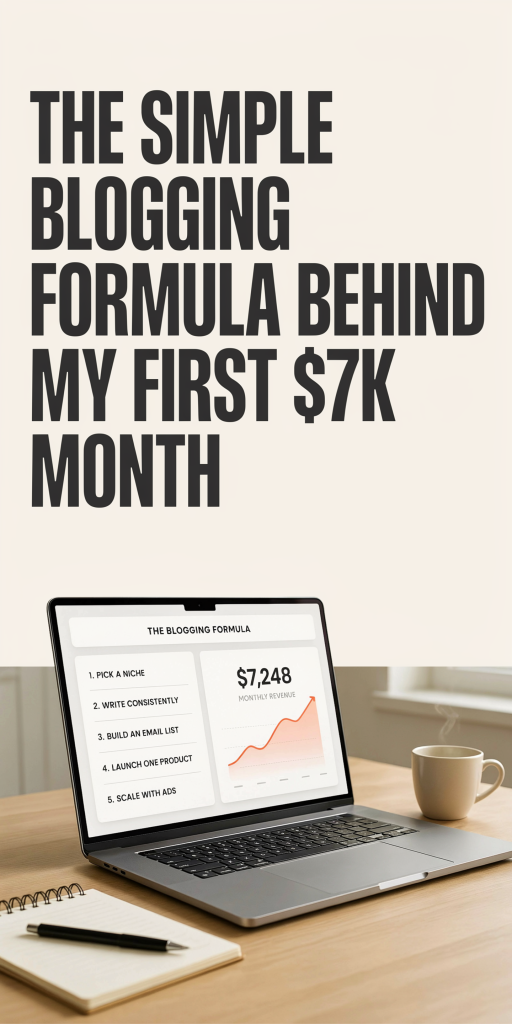
– My first $7K month was split roughly: $4k course sales, $2k affiliates, $1k consulting. The course was my core offer — a focused training for bloggers about building funnels — and that clarity made my messaging consistent across posts, emails, and ads.
Ready for a guided, five-day action plan?
Build content as a funnel: awareness → engagement → conversion
Why it mattered
– Random blog posts get random results. Designing content as stages of a funnel gives you control: attract, nurture, convert.
Actionable tips
– Plan pillar posts (top-of-funnel) that target high-volume keywords and answer broad queries. Aim for 1–3 pillar pieces that cover the core topics of your niche.
– Create supporting posts (middle-of-funnel) that go deeper and link to pillar posts and your lead magnet. These are the posts that push readers toward your email list.
– Write bottom-of-funnel pages: product pages, case studies, and detailed tutorials that directly promote your offer.
– Use content upgrades in posts (a checklist, template, or mini-course) to increase opt-in rates by 2–5x.
Real-world context
– I used a pillar post on “How to build a 3-step blog funnel” to drive organic traffic. Supporting posts were practical how-tos like “7 email sequences that convert” and each included a content upgrade. The funnel structure meant each new post had a clear job — not just “get views.”
Make email your primary conversion engine
Why it mattered
– Social traffic disappears; search traffic grows slowly. Email gives you direct access to readers and the ability to make offers without algorithm interference.
Actionable tips
– Use a reliable email provider (ConvertKit, ActiveCampaign, or similar). Keep your sequence focused: welcome → value → social proof → soft pitch → hard pitch.
– Aim for a 20–40% open rate and a 1–5% click-to-purchase rate on promotional sequences for a new course/offer.
– Segment subscribers by interest (e.g., beginners vs. advanced) after the lead magnet. Send targeted promotions for higher conversions.
– Re-engage cold subscribers with a re-onboarding sequence before removing them.
Real-world context
– My lead magnet was a simple “Blog Funnel Checklist” that perfectly matched my course content. My welcome sequence delivered immediate value and included a case study email showing exact sales numbers, which built trust. When I launched the course, my email list accounted for 60–70% of sales that month.
Drive traffic with SEO + one paid channel
Why it mattered
– A balanced traffic strategy avoids putting all your eggs in one basket. SEO provides compounding long-term traffic; one paid channel accelerates growth and provides immediate feedback on offers.
Actionable tips
– Start with keyword clusters: choose pillar keywords then write supporting posts targeting secondary keywords. Use tools like Ahrefs, Semrush, or free options like Google Search Console to find low-difficulty topics.
– Optimize on-page SEO: strong titles, descriptive meta, H2s with keywords, and internal linking to funnel pages.
– Pick one paid channel to start (Facebook Ads or Google Ads). Test with small budgets ($10–$50/day) to validate lead magnet and tripwire performance before scaling.
– Track ROI by campaign, not just clicks. Use UTM tags and tie ad spend to revenue generated by those leads.
Real-world context
– I focused my SEO efforts on long-tail phrases that map to blog funnel steps, and ran a small Facebook ad to a webinar that converted 3% of registrants into buyers. That ad paid for itself and scaled when I doubled down.
Optimize conversions: simple tests that move the needle
Why it mattered
– Small conversion improvements compound quickly. Increasing opt-in rate from 2% to 4% or average order value by 10% can dramatically boost monthly revenue.
Actionable tips
– Start with the high-impact elements: headline, CTA copy, and lead magnet image. Run A/B tests one at a time.
– Use heatmaps (Hotjar, Microsoft Clarity) to spot friction on pages.
– Add urgency and scarcity in a genuine way: limited bonuses, quick-start coaching spots, or launch-only price.
– Upsell at checkout: a low-cost add-on or a subscription increases average order value.
Real-world context
– A simple headline tweak and adding a short video to my sales page boosted conversions by 18%. Offering a $47 workshop as a checkout upsell increased average order value and was responsible for an extra $600 that month.
Habits and systems that keep you growing
Why it mattered
– Revenue isn’t a one-off; it’s a product of repeatable habits. Systems reduce decision fatigue and keep momentum.
Actionable tips
– Batch content creation: write multiple posts in one session, then schedule publishing and promotion.
– Follow a 90-day sprint: set one revenue goal (e.g., $5K/mo), list 3 priorities (content, list growth, paid ads), measure weekly.
– Track 5 KPIs: traffic, subscribers, lead conversion rate, sales conversion rate, revenue per visitor.
– Outsource or automate low-value tasks: podcast editing, social graphics, and basic SEO edits.
Real-world context
– I blocked Mondays for content creation, Tuesdays for email writing, and used the rest for promotion and analysis. That routine reduced stress and made it easier to hit consistent publishing and promotion targets.
Measure, iterate, and be patient
Why it mattered
– Blogging funnels compound, but they don’t always scale linearly. Measurement tells you where to double down and where to stop wasting time.
Actionable tips
– Use Google Analytics and your email provider to map the reader journey: where are people dropping off? Which posts produce most buyers?
– Calculate lifetime value (LTV) and customer acquisition cost (CAC) for each channel. If CAC < 30–40% of LTV, you can scale that channel.
– Iterate monthly. Double down on what works (topic clusters, ad creative, email sequences) and cut what doesn’t.
Real-world context
– By month three of focusing on one funnel, I could predict revenue within ±15% because I had repeatable conversion rates and predictable traffic growth. That predictability made it easier to invest back into ads and content.