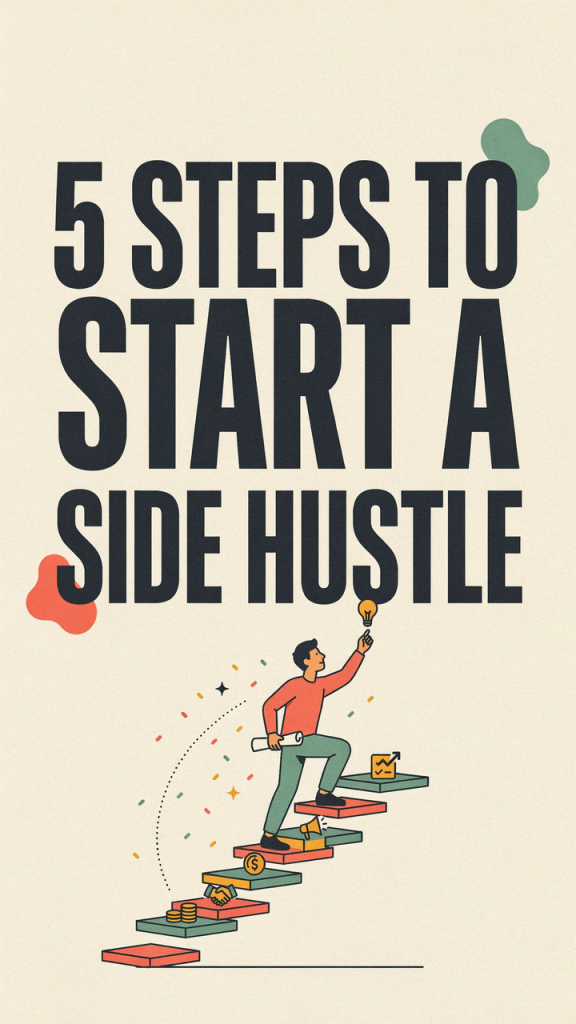
Starting a side hustle is more than a way to earn extra cash — it’s a practical way to build skills, test business ideas, and increase financial flexibility while keeping your main responsibilities intact. For stay-at-home parents and anyone juggling family or day jobs, the key is planning realistically: choose an idea that fits your life, protect your time and money, and take stepwise action so the hustle helps you, not hurts you.
Why plan before you start
Knowing what you want from a side hustle (income, creative outlet, business potential, or a runway to full-time) clarifies every decision that follows. Planning reduces wasted effort, lowers stress, and makes it easier to measure progress. A clear plan doesn’t have to be complex — it just needs honest answers about your time, financial buffer, and limits so you can select an option that’s sustainable for your life stage.
Readiness checklist (use this before saying “yes”)
Score each item 0–2 (0 = no, 1 = partial, 2 = yes). Add scores; 12–14 means you’re ready to launch, 8–11 means you can launch with fixes, under 8 means work on foundations first.
- Financial cushion: Do you have 1–3 months of essential expenses or a small allotment for startup costs? (0–2)
- If low: set a small sinking fund ($500–$1,000) or choose a no-cost hustle (freelancing, selling items).
- Available weekly time: Can you reliably commit X hours/week? (state your realistic X) (0–2)
- If partial, plan micro-hours (30–90 minutes blocks).
- Clear goal: Do you know what you want from this hustle (target monthly amount or skill)? (0–2)
- Marketable skills: Do you have skills others will pay for or can you learn them cheaply? (0–2)
- Support system: Is there at least one person who can help with childcare, logistics, or accountability? (0–2)
- Minimum compliance covered: Have you checked basic legal/tax/licensing needs? (0–2)
If you score under 8, take concrete next steps: create a 4-week schedule, build a $500 cushion, or take a short skills course. Practical progress on these items raises your readiness quickly.
Decision criteria for choosing the right side hustle
Not every hustle fits every life. Use these criteria to compare ideas:
- Income potential vs. time investment: Estimate realistic hourly earnings after costs. If you need $400/month and can work 10 hours, you need to earn ~$40/hr after expenses.
- Up-front cost and risk: Can you start with <$100? If not, do you have a plan to finance it without stress?
- Time flexibility and scheduling fit: Does the work allow for fragmented hours (good for parents) or require large uninterrupted blocks?
- Skills required and learning curve: Can you start at a basic level and iterate, or does it require expert-level skills immediately?
- Scalability: Do you want this to stay small, or grow into a business? Choose gigs vs. products/services accordingly.
- Emotional fit: Will this task drain or energize you after family duties? Pick something that matches your energy pattern.
Score options by these criteria to choose one that aligns with your goals and limits.
Time-budgeting guidance: realistic patterns that work
Start by committing to a weekly hour budget you can maintain for 3 months. Typical brackets:
- 3–5 hours/week: Validate ideas, list items, take microtasks, write short posts, do simple resale. Tasks: profile setup, one product/service launch, 1–2 outreach messages.
- 6–10 hours/week: Freelance gigs (writing, design), virtual assistance, tutoring. Tasks: client work, simple marketing (1 social post/week), bookkeeping.
- 11–20 hours/week: Small service business, online courses, regular content creation. Tasks: client pipeline, weekly content, systems development.
Weekly scheduling tips:
- Block time in advance: pick recurring blocks (e.g., 8–10 am Tue/Thu, or 1 hour during kids’ nap). Treat them as appointments.
- Batch work: do similar tasks together (emails, content, admin) to reduce switching costs.
- Protect high-focus hours: do client or deep work when interruptions are lowest.
- Use 25/50 minute focused sprints with 5–10 minute breaks to maintain momentum.
- Reserve one “planning hour” each week to review finances, pipeline, and next steps.
Example micro-schedule for a stay-at-home parent (10 hours/week):
- Mon 8:00–9:00 am: Client work or product creation (2)
- Tue 12:30–1:30 pm: Marketing (social, listings) (1)
- Wed 8:00–9:30 am: Client work (1.5)
- Thu 1:00–2:00 pm: Outreach and networking (1)
- Sat 9:00–11:00 am: Batch creation / admin (2)
- Sun 30 min: Weekly plan (0.5)
Adjust based on energy and family routines.
Risk considerations and how to limit them
Side hustles carry multiple risks. Identify them and set rules to manage exposure.
- Financial risk: Avoid large upfront expenses. Rule: no more than X% of your emergency fund in business costs. Start with free or low-cost tools and upgrade only after revenue.
- Time risk: Set review checkpoints (30–60 days). If traction is below predefined metrics (e.g., bookings, leads, $ earned), pivot or pause.
- Legal/tax risk: Use simple bookkeeping from day one. Keep separate bank account or sub-account. Learn basic tax obligations in your locality; consult an accountant if needed.
- Reputation risk: Use clear contracts or written terms for client work. Offer limited revisions and timelines to avoid scope creep.
- Conflict-of-interest risk: Check your employment contract if you work outside the home. Avoid using employer resources for your side hustle.
Practical first-step actions to choose and launch (a 10-step sprint)
1. Define your “why” and target outcome (exact monthly $ or skill). Write it down.
2. List 6 ideas that match your skills and goals.
3. Score each idea with decision criteria above and pick top 2.
4. Validate demand: talk to 10 potential customers, post a simple poll, or test a $1–5 offer.
5. Create an MVP (minimum viable product/service) — a simple service page or single product listing.
6. Price realistically: calculate hourly rate target and set initial pricing to test.
7. Set up basic systems: a place to accept payments (PayPal, Stripe), simple invoice template, and a spreadsheet for income/expenses.
8. Create a one-page web presence (site builder or social profile) with contact info and 3 examples of work or benefits.
9. Schedule your first 4 weeks: two blocks of client/creation time and one marketing block weekly.
10. Soft-launch: offer to friends, community groups, or local customers first, collect feedback, then iterate.
Sample outreach script (short):
“Hi — I’m launching [offer]. I help [customer] with [result] and currently offering a pilot rate for feedback. Would you be open to trying this for [price] and sharing candid feedback?”
Quick growth levers without burning out
- Referrals: ask every satisfied customer for one referral and offer a small discount for both.
- Templates and systems: create templates for proposals, emails, and invoices to save time.
- Outsource small tasks when revenue allows (e.g., bookkeeping, photo editing).
- Build social proof fast: document small wins, before/after, or client testimonials.
- Partner locally: collaborate with complementary service providers to cross-refer.
Limits and realistic expectations
Expect slow starts. Most side hustles take weeks or months before meaningful income arrives. Treat early months as market research and skill-building. Use pre-set stop-loss rules (“If after 90 days I haven’t made $X or booked Y clients, I’ll pivot or pause”) to protect time and morale. Don’t compare your beginning to someone else’s midstream success.
Closing thoughts
A side hustle should expand your options, not drain your energy. Start with honest readiness checks, choose an idea that fits your life and time, set simple systems to manage money and clients, and commit to short, measurable review windows. With realistic planning, small wins compound — and the extra income, skills, and independence you build will reflect the care you put into the plan.
Build a practical AI-powered income plan in five days
Get a step-by-step framework for turning your skills and available time into a focused AI-powered side-income offer.
Three fast validation experiments (setup, cost, time, and exit rules)
1) Direct pilot outreach (low cost)
- Setup: Identify 15–30 ideal prospects, craft a 3-line offer, and send personalized messages.
- Time/cost: 4–6 hours total; $0–$10 (messaging tools).
- Success metric & exit rule: ≥10% positive responses or 2 booked pilots in 2 weeks → keep iterating. If zero responses, refine message or target.
2) Paid micro-test (traffic + sign-up)
- Setup: Run a small ad or boosted post to a landing page with one-sentence offer and email capture.
- Time/cost: $25–$100 budget; 2–4 hours to create.
- Metric & exit: ≥50–100 clicks and a 3–5% sign-up rate in 7–14 days → scale. Under those numbers, stop and revise offer/creative.
3) Discounted limited pilot (revenue proof)
- Setup: Offer 3 discounted paid slots (30–50% off) to early users with feedback requirement.
- Time/cost: 6–12 service hours; revenue tradeoff acknowledged.
- Metric & exit: At least 2 paid customers and actionable feedback in 30 days → continue. If none, pause and reassess fit or pricing.
Run one experiment at a time, measure honestly, and use the results to pick one sustainable path forward.