In a digital landscape dominated by search engines like Google, it might seem counterintuitive to focus on an alternative platform for driving substantial web traffic. However, relying solely on Google has become increasingly precarious. Search algorithms change constantly, and recent core updates have wiped out millions of pages’ rankings overnight. Achieving strong Google visibility demands high-quality backlinks, technically optimized content, months of waiting, and often a significant advertising budget. For new bloggers and content creators, this creates an enormous barrier to entry.
While everyone else fights a losing battle for Google’s top spot, there is a quieter, highly effective alternative: building a massive, automated traffic machine on Pinterest. By applying a unique set of strategies, it is possible to generate over 400,000 visits to a website directly from Pinterest, completely sidestepping the complexities of traditional SEO. This article provides a complete, step-by-step blueprint for turning Pinterest into your primary traffic source.
Pinterest Is Not Social Media — It’s a Search Engine
The most common mistake marketers make is treating Pinterest like a traditional social media network. Pinterest is not a platform for scrolling through updates from friends; it is an incredibly powerful visual discovery engine. When users search on Pinterest, they are in a discovery mindset. They are actively looking for inspiration, answers, and solutions. This means that content on Pinterest tends to lead to higher engagement rates and attracts users who are open to exploring external links.
The scale of the platform is immense. As of recent data, Pinterest boasts over 553 million monthly active users worldwide, with nearly 90 million users in the United States alone. The platform is experiencing a 23.2% year-over-year audience growth, making it one of the fastest-growing platforms globally. Furthermore, a staggering 97% of searches on Pinterest are unbranded. Users are searching for ideas rather than specific companies, which provides a massive opportunity for new creators to capture attention.
Ready To Build A More Flexible Income Stream?
Why Pinterest Beats Google for New Creators
Pinterest levels the playing field in a way that Google simply does not. It is one of the few platforms where a brand-new account can compete with established players from day one. The algorithm rewards fresh, visually compelling content rather than years of authority building or expensive link acquisition campaigns.
Unlike Google, where a new blog can sit in the “sandbox” for six to twelve months before ranking, Pinterest can begin sending traffic within 48 to 72 hours of your first pin. Additionally, Pinterest content has a remarkably long shelf life. A well-optimized pin can resurface organically and drive traffic for an average of 3.5 months, creating an evergreen traffic engine. This makes Pinterest especially powerful for niches like food, fashion, home décor, DIY, personal finance, health, travel, and blogging.
To illustrate the stark differences between the two platforms, consider the following comparison:
| Metric | Google SEO | |
|---|---|---|
| Time to first traffic | 48–72 hours | 6–12 months |
| Domain authority required | None | High |
| Content lifespan | 3.5+ months (evergreen) | Variable |
| Algorithm volatility | Low | High (frequent updates) |
| Cost to start | Free | Free (but time-intensive) |
| Visual content advantage | Massive | Minimal |
| Purchase intent | Very high (85% have bought) | Variable |
| Competition level | Lower | Extremely high |
The Pinterest Traffic Blueprint: 6 Core Pillars
Driving 400,000 website visits from Pinterest is not the result of luck or a single viral post. It is the product of a repeatable, systematic approach built on six interconnected pillars. Each pillar compounds the others, creating a traffic flywheel that grows with every pin published.
Pillar 1: Niche Positioning
The single biggest mistake Pinterest beginners make is trying to cover too many topics. Pinterest’s algorithm rewards topical authority. Accounts that consistently publish content within a defined niche receive preferential distribution because the algorithm can accurately predict who to show the content to. Niche specificity drives significantly more clicks than broad, generic content. By positioning your content as a valuable, niche-specific resource, you attract a targeted audience that is highly likely to click through to your website. Aim to be the premier resource for one specific topic before expanding your scope.
Pillar 2: Pinterest Keyword Research
Because Pinterest is a search engine, it operates on its own SEO system. Pins optimized with the right keywords appear in search results, category feeds, and the home feeds of interested users. Keyword research for Pinterest is straightforward but critical. The goal is to embed relevant, high-volume keywords into every layer of your Pinterest presence, including your profile bio, board names, board descriptions, pin titles, and pin descriptions.
The most effective method is to use the Pinterest search bar to find autocomplete suggestions, which represent real user queries. Targeting long-tail keywords consisting of three to five words often yields lower competition and higher intent.
Pillar 3: Pin Design
Pinterest is a visual platform, and the quality of your pin design is the single most important factor in determining whether a user clicks or scrolls past. A well-designed pin can outperform a mediocre one by an order of magnitude. Visual appeal is paramount.
Best practices for pin design include using a vertical format with a 2:3 ratio (typically 1000 by 1500 pixels), as vertical pins occupy more feed space. Employ bold, readable text overlays with high-contrast colors to ensure the text pops against the background. Pins featuring faces tend to receive significantly higher engagement. Above all, the pin must communicate a clear value proposition, answering the user’s implicit question: “What will I get if I click?”
Pillar 4: Consistent Scheduling
Consistency plays a crucial role in maintaining visibility on Pinterest. The algorithm rewards frequent, consistent activity. Unlike other platforms where posting too much can hurt engagement, Pinterest is designed for high-volume pinning. The optimal strategy involves pinning 10 to 25 times per day, mixing your own fresh content with repins of top-performing niche content.
Because manual pinning at this volume is unsustainable, automation is essential. Utilizing scheduling tools allows you to batch-create pins and schedule them for optimal posting times, such as evenings and weekends, ensuring a steady flow of content without overwhelming yourself.
Pillar 5: Profile & Board Optimization
A well-crafted Pinterest profile acts as a digital front door for your brand. It is the foundation of your strategy, signaling to both users and the algorithm exactly what your account is about. A fully optimized profile functions as a 24/7 traffic funnel.
Optimization begins with upgrading to a free Pinterest Business account to unlock analytics and rich pins. Your profile name and bio should clearly convey your niche and integrate primary keywords. Claiming your website is a necessary step to enable rich pins and track analytics. Furthermore, creating 10 to 20 organized, focused boards with keyword-rich descriptions and branded cover images significantly improves the user experience and search visibility.
Pillar 6: Group Boards & Pinterest Communities
Joining Pinterest communities and group boards can amplify your reach exponentially. Group boards are collaborative spaces where multiple contributors pin content. When you pin to a group board, your content is exposed to all followers of that board, allowing you to tap into a broader audience without needing a massive personal following.
When selecting group boards, focus on those with active engagement and strict niche alignment. Quality always supersedes quantity; a few highly active group boards will outperform dozens of inactive ones. Active participation, such as repinning and commenting on others’ content, helps build relationships and establishes your presence in the community.
The Analytics Loop: Measure, Learn, Optimize
Measurement is the key to continuous improvement. Data is the difference between guessing and growing. Pinterest’s built-in analytics dashboard provides detailed insights into which pins drive the most impressions, clicks, saves, and outbound link clicks.
Outbound clicks are the most critical metric, as they represent actual website traffic. By regularly monitoring this data, you can identify patterns, such as the types of graphics and topics that resonate most with your audience. This feedback loop allows you to adapt your strategies, doubling down on top-performing pin styles and retiring underperforming content.
The Content Types That Drive the Most Traffic
Not all content performs equally on Pinterest. Through rigorous testing and analytics review, clear patterns emerge regarding which content formats drive the highest click-through rates.
Top-performing Pinterest content types include:
- Tutorials and “How-To” Guides: Step-by-step visual instructions that promise a clear outcome.
- Infographics: Data-dense, visually organized information that provides immediate value.
- List-Based Pins: Formats like “10 Ways to…” that drive high curiosity clicks.
- Before and After Pins: Visual transformations that captivate users.
- Seasonal and Trending Topics: Content aligned with holidays or rising search trends.
To maximize reach, it is highly recommended to create three to five different pin designs for every piece of content, testing various headlines and visual styles.
Tools of the Trade: The Pinterest Traffic Stack
Building a high-volume Pinterest traffic system requires the right toolkit. Fortunately, the essential tools are accessible and often free or low-cost.
- Canva: The premier design tool for creating professional Pinterest graphics, offering pre-sized templates and brand consistency features.
- Tailwind: The industry-standard scheduling tool that automates the pinning process and optimizes posting times.
- Pinterest Trends: A native research tool that identifies rising and seasonal search trends.
- Pinterest Analytics: The built-in dashboard for tracking performance metrics and audience insights.
- Google Analytics: Essential for tracking Pinterest referral traffic, bounce rates, and conversions on your actual website.
The 90-Day Pinterest Launch Plan
Building a functioning Pinterest traffic engine takes time and consistency. Following a structured 90-day roadmap ensures you build a solid foundation before scaling.
Phase 1: Foundation (Days 1–30)
Focus on setting up and optimizing your Business account, claiming your website, and creating keyword-optimized boards. Design your initial batch of pin templates and set up your scheduling tool to automate your first month of content.
Phase 2: Momentum (Days 31–60)
Ramp up your pinning volume to 15–25 pins per day. Begin creating multiple pin variations for existing content and publish new, Pinterest-optimized blog posts. Start joining relevant group boards and engaging with the community.
Phase 3: Optimization (Days 61–90)
Use your analytics to identify early top performers. Double down on the styles and topics that are working. Refine your content strategy based on audience insights and set concrete traffic goals for the future.
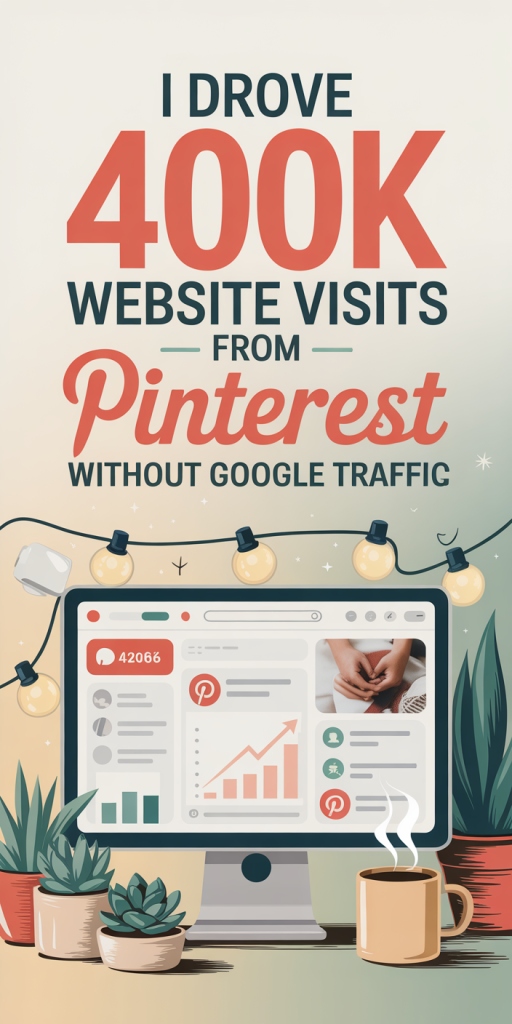
Real Results: What 400,000 Visits Actually Means
Traffic is not the end goal; it is the vehicle for business growth. Driving 400,000 website visits from Pinterest translates into tangible, compounding business results.
To put this into perspective, at a standard 2% email opt-in rate, 400,000 visits generate 8,000 new email subscribers. At a 1% affiliate conversion rate, it results in 4,000 affiliate sales. If monetized with display ads, it can yield thousands of dollars in passive revenue. These numbers compound over time as subscribers become repeat visitors and Pinterest traffic continues to flow, creating a passive engine that works around the clock.
Driving massive website traffic without relying on Google is not only achievable but is often a superior strategy for new brands and creators. By understanding Pinterest’s unique advantages as a visual search engine, crafting engaging content, maintaining a consistent pinning schedule, and actively participating in the community, you can transform your Pinterest presence into a substantial, evergreen traffic source.
The blueprint is clear: establish your niche, master keyword research, design scroll-stopping pins, automate your scheduling, optimize your profile, and leverage group boards. With dedication and a data-driven approach, your efforts on Pinterest will lead to significant traffic gains and a thriving online business.