We used to think budgets were restrictive, boring spreadsheets for other people, until we tried a simple, repeatable system that made money predictable and purposeful. This article walks through a straightforward 3-step formula we adopted that changed how we manage money. No complex rules, no perfect math: just a clear process: track, allocate, and automate. If you’re new to budgeting and want something practical that actually sticks, read on. We’ll show the how, the why, and the real-life tweaks that help this work for irregular paychecks, debt, and busy families.
Why Budgeting Matters — A Quick Reality Check
We’ll start with a blunt truth: without a plan, money quietly picks the priorities. Small, repeated choices, a few lunches out, subscriptions we forget we have, or a missed transfer to savings, add up and steer our lives. Budgeting isn’t about depriving ourselves: it’s about deciding where our money goes instead of being surprised at the end of the month.
Here’s what we saw when we began budgeting: less stress about bills, clearer decisions on purchases, and steady progress toward goals like emergency savings and paying down debt. The psychological effect is powerful. When we can point to numbers and rules, we replace anxiety with action. Small wins (an unexpected $200 saved, a paid-off credit card) compound into bigger choices: a better job decision, travel, or investing for the future.
A few quick reality checks to motivate us:
- Most people who don’t track spending don’t know where 20–30% of their monthly cash is going. That’s not judgment, it’s invisibility. We made it visible.
- Emergencies happen. An emergency fund reduces the chance that we’ll use high-interest credit when life throws a curveball.
- Budgeting increases our options. When we plan, we choose how to spend: more freedom, not less.
If we keep one thing from this section, it’s this: budgeting is a tool for freedom. The only commitment required is consistency.
Ready To Build A More Flexible Income Stream?
How The 3-Step Formula Works: Overview
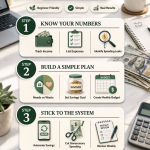
Our 3-step formula is intentionally simple so we’d stick with it. The steps are:
- Know where your money goes (track income and spending).
- Set simple, realistic rules (priorities, goals, allocations).
- Build habits and adjust (automate, review, improve).
Think of it as a loop: tracking shows reality, rules convert reality into a plan, and habits make the plan durable. We run the loop monthly, with quarterly check-ins for bigger life changes.
Why this structure? Because complexity kills follow-through. We needed something that fit into busy lives, worked for irregular incomes, and scaled as our financial lives got more complicated. Each step has practical tactics and small time commitments, minutes a day or an hour a month, but yields outsized results.
Below we unpack each step with practical examples, common pitfalls, and specific actions we used to make the system stick.
Step 1 — Know Where Your Money Goes (Track Income And Spending)
When we started, Step 1 felt like the least glamorous part, but it’s the foundation. We can’t control what we don’t measure.
Why Tracking Matters
Tracking forces reality into the open. We might think we spend little on dining out, but the numbers reveal patterns, a weekly coffee habit, subscriptions we ignore, or impulse buys after stressful days. Tracking gives us a baseline: if we don’t know our starting point, any plan is guesswork.
Tracking also uncovers opportunities. We found recurring charges for services we no longer used, insurance discounts we hadn’t claimed, and small categories where trimming a bit would free cash for savings.
Practical Ways To Track (Apps, Envelopes, Spreadsheets)
We tried several tracking methods and recommend picking one that meets three criteria: low friction, consistent updates, and clarity.
- Apps (Mint, YNAB, Simplifi, Personal Capital): Great for automatic categorization and quick overviews. YNAB forces intentional allocation, which aligns with Steps 2 and 3. Apps are best if we want automation and mobile access.
- Spreadsheets: Flexible and transparent. We used a simple monthly sheet with columns for income, fixed bills, variable spending, and transfers to savings. Spreadsheets are ideal if we like control and customization.
- Envelopes (physical or digital): For discretionary cash categories (food, entertainment), envelopes work wonders to prevent overspend. Physically seeing the money disappear is a strong behavioral cue.
- Hybrid approach: We synced accounts to an app for automatic tracking, then maintained a small spreadsheet for rule-based allocations. That combo gave us accuracy plus intentionality.
Practical tip: start tracking every expense for two weeks straight. After that short period, we usually see 80% of the patterns, enough to make effective decisions.
Common Tracking Pitfalls And How To Avoid Them
- Pitfall: Waiting for perfect categories. We resisted paralysis by analysis by starting with broad categories: housing, transport, food, subscriptions, savings, debt, misc. We refined categories later.
- Pitfall: Not reconciling. Automations can mislabel transactions: we spent 15 minutes weekly cleaning up mis-categorized items so reports were useful.
- Pitfall: Tracking forever without acting. Data is only useful if it triggers allocations and rules. That’s why Step 2 matters, convert insight into decisions.
Tracking is the honest first step. Once the numbers are visible, we can design rules that fit our lives.
Step 2 — Set Simple, Realistic Rules (Priorities, Goals, And Allocations)
Rules remove decision fatigue. Instead of deciding each time we get paid, we follow a few simple allocations that reflect our priorities.
Choosing Priorities: Needs, Wants, Savings
We start by listing priorities in three buckets: needs, wants, and savings/debt reduction. Needs are bills we must pay (rent/mortgage, utilities, minimum loan payments). Wants are discretionary but meaningful (dining out, hobbies). Savings/debt reduction includes emergency fund, retirement, and extra debt payments.
As a group, we discuss what matters most. For some of us, saving for a house is priority: for others, paying down credit card debt takes precedence. The point is to be explicit. We commit to allocations that reflect those priorities.
A Simple Allocation Method (Percentages And Example Budgets)
We like simple percentages because they’re easy to remember and adjust. Here’s a baseline model we used and adapted:
- 50% Needs: housing, utilities, groceries, minimum debt payments, insurance.
- 30% Wants: dining out, entertainment, subscriptions, nonessential shopping.
- 20% Savings & Debt Reduction: emergency fund deposits, retirement contributions, extra loan payments.
Example: If our net monthly income is $4,000:
- Needs (50%): $2,000
- Wants (30%): $1,200
- Savings/Debt (20%): $800
We rarely followed these percentages rigidly at first. Instead, we used them as a guide and adjusted. When debt was high, we shifted to 40/20/40, more on debt, less on wants. When our emergency fund reached three months of expenses, we funneled more into investments.
Alternative methods:
- Zero-based budgeting: every dollar gets a job. This is precise but requires more setup.
- Pay-yourself-first: move savings immediately when paid, then spend what’s left. This reduces temptation to skip savings.
We found combining pay-yourself-first with a simple percentage allocation gives both discipline and flexibility.
Turning Goals Into Small, Achievable Targets
Big goals intimidate. We found it easier to break them into monthly or weekly milestones. Instead of “save $12,000 this year,” we aimed to save $1,000 per month and then $250 per week. Small, visible wins kept morale up.
We also used micro-goals for behavior: no dining out two nights a week, cancel one unused subscription this month, or set up an automatic $50 transfer to savings every payday. These small habits rapidly compound.
Finally, we celebrated non-financial wins: choosing a home-cooked meal with friends, finding new free weekend activities, or knocking out a small debt. Those positive reinforcements made the rules feel rewarding rather than punitive.
Step 3 — Build Habits And Adjust (Automate, Review, Improve)
A budget without habits is temporary. Step 3 is about embedding the process so it runs even when we’re busy or stressed.
Automations That Make Budgeting Passive
Automation turned budgeting from an effort into a default. We automated three things:
- Bills and minimum payments: set these to autopay to avoid late fees and stress.
- Savings transfers: on payday we move a set amount to savings and retirement accounts before we can spend it. Out of sight, out of temptation.
- Category-specific rules: some banks and budgeting apps let us tag transactions or route funds to buckets automatically (e.g., 5% of income goes to a vacation bucket).
These automations reduced mental load. We still monitored accounts, but the default action aligned with our goals.
Monthly And Quarterly Review Checklist
We review monthly and do a deeper quarterly check. Our monthly checklist takes 20–30 minutes:
- Reconcile spending for major categories.
- Ensure savings transfers ran correctly.
- Move leftover discretionary funds to a purposeful place (debt payoff, investment, or rollover for next month).
Quarterly, we spend 60–90 minutes on bigger questions:
- Are our allocations still aligned with priorities?
- Have incomes or recurring expenses changed?
- Are there upcoming life events (move, baby, job change) that require a new plan?
We keep a simple log of decisions: what changed and why. That history helps when we revisit a similar situation later.
How To Tweak The Formula When Life Changes
Life changes, wages grow, family expands, medical bills arrive. We adapt the formula rather than abandon it.
- For a raise: we recommend splitting the increase, keep essential spending stable, add a portion to fun, and the rest to savings or debt. We called this the 40/40/20 raise rule: 40% stay in spending, 40% to savings/debt, 20% to fun.
- For job loss or reduced income: cut discretionary spending first, pause nonessential subscriptions, and shift allocations to protect emergency savings for essentials.
- For a new child or home purchase: increase the frequency of reviews and create new buckets (childcare, moving costs, maintenance) so surprises don’t derail the plan.
The core principle: small, timely adjustments keep the system resilient without requiring a complete restart.
Handling Common Beginner Challenges (Irregular Income, Debt, Emotional Spending)
Budgets often fail when they don’t match life’s messiness. Here’s how we handled the common challenges that trip beginners up.
Irregular Income
For freelancers or commission-based pay, we created a baseline by averaging the past 6 months of income. Then we used a buffer approach:
- Priority 1: cover fixed costs using a conservative monthly baseline.
- Priority 2: build a buffer equal to 1–2 months of expenses (more if income is highly volatile).
- Priority 3: allocate surplus months to savings or tax obligations.
We also adopted a “pay baseline” model: when a big payment arrived, we distribute it across future months so essential bills remain predictable.
Debt
High-interest debt changes the math. We accelerated debt paydown by temporarily shifting allocations: reduce wants, increase debt payments, and avoid new consumer credit. We used these tactics:
- Snowball method: pay smallest debts first for motivational wins.
- Avalanche method: pay highest-rate debt first for math-optimal savings on interest.
- Balance transfers or consolidation: only if the fees and timeline make sense.
Emotional Spending
Emotional spending is normal. We didn’t eliminate it, we managed it. A few tactics helped:
- Pause rule: add temptations to a 48-hour waiting list. Most impulse buys fade.
- Replace ritual spending: if we spend for stress relief, find lower-cost rituals (walks, coffee at home, call a friend).
- Allow a guilt-free fun budget: when we ban joy, we rebound. A modest monthly “treat” allowance reduces sneaky overspend.
We didn’t need to be perfect: we needed consistent. Over time, the frequency of emotional spending dropped because our stress level from money decreased.
Quick Wins To Boost Momentum In The First 30 Days
Momentum is everything. In the first month we suggest three quick wins:
- Automate one savings transfer and one bill payment.
- Cancel one subscription you haven’t used in the last three months.
- Track all expenses for two weeks and identify one category to cut by 20%.
These actions take little time and provide immediate psychological payoff.
When To Seek Help: Financial Tools, Planners, And Counselors
We used tools first, apps, spreadsheets, and calculators, but sometimes professional help is the right choice. Consider seeking outside help when:
- Debt interest is spiraling and collections are imminent.
- You’re making major life decisions (buying a home, changing careers) and want a sanity check.
- You feel overwhelmed and avoid looking at numbers for months.
Look for fee-only planners, nonprofit credit counselors, or community financial coaches who prioritize education over sales. A short session can clarify options and create a plan that keeps us moving.
Real-Life Examples: Two Short Case Studies (Single Person And Family)
Concrete examples make the process believable. Here are two short case studies based on what we and people we know actually did.
Example Budget Breakdown And Before/After Results
Case 1, Single Person (Alex)
- Situation before: $3,200 monthly net income, no emergency fund, $6,000 credit card balance at 18% APR. Spending felt “tight” but inconsistent: lots of dining out, multiple subscriptions, missed minimums occasionally.
- Action steps: Tracked spending for two weeks, identified $350/month in subscriptions and unused services. Adopted a 40/30/30 temporary allocation: 40% needs ($1,280), 30% wants ($960), 30% debt/savings ($960). Automated $400/month to debt and $200 to emergency savings.
- Results after 9 months: Emergency fund of $1,800, credit card balance reduced to $3,000, dining out down 40% (saved $160/mo). Monthly stress decreased: Alex reported better sleep and fewer “financial surprises.”
Case 2, Family (The Parkers)
- Situation before: Combined $6,500 net monthly income, two young kids, no consistent system. Overspending in groceries and childcare surprises: no dedicated sinking funds.
- Action steps: Averaged three months of income and set a baseline. Built a buffer equal to one month’s expenses, created sinking funds for holiday gifts and car maintenance, and used a 50/25/25 split for essentials/wants/savings (adjusted to 55/20/25 during a tight period). They automated 10% of income to retirement and set a weekly family money meeting to review progress.
- Results after 12 months: Buffer of $6,500, predictable childcare line item, and a $3,000 emergency fund. Reduced stress around unexpected expenses and more intentional spending on experiences.
Lessons Learned And Small Tweaks That Make Big Differences
From both examples, we pulled common lessons:
- Visibility matters. Tracking exposed the problem areas.
- Automations lock in good behavior faster than willpower alone.
- Small, consistent targets are more effective than big, vague goals.
- Family involvement (or an accountability partner) creates shared priorities and fewer financial arguments.
Small tweaks that helped include rounding savings transfers up to the nearest $10 (psychological boost), using calendar reminders for quarterly reviews, and keeping a visible list of short-term goals to maintain motivation.
We didn’t start perfect. We started practical. The 3-step formula, track, set rules, and automate, gave us a structure that fit busy lives and imperfect incomes. It reduced stress, increased options, and turned vague wishes into measurable progress.
If you take one thing away, let it be this: pick a simple system and commit to it for three months. Track honestly, make a handful of realistic rules, and automate the small stuff so the system survives real life. The first month will be the hardest: the third month is when momentum builds, and after six months you’ll see meaningful change.
Budgeting isn’t about giving up what we love, it’s about making space for what matters. Start small, be consistent, and adjust when life changes. We’ve done it, and you can too.