We built an email funnel that turned our blog from a traffic-only hobby into a revenue-generating machine in 30 days. No magical traffic hack, just a clear funnel, a tight list-building play, and email sequences engineered to move people from curious readers to paying customers. In this post we’ll show what we built, why it worked, and exactly how you can replicate it in a month. Expect concrete steps, sample sequences, timing, and the KPIs we watched while scaling a small blog into a profitable business fast.
What I Built And Why It Worked
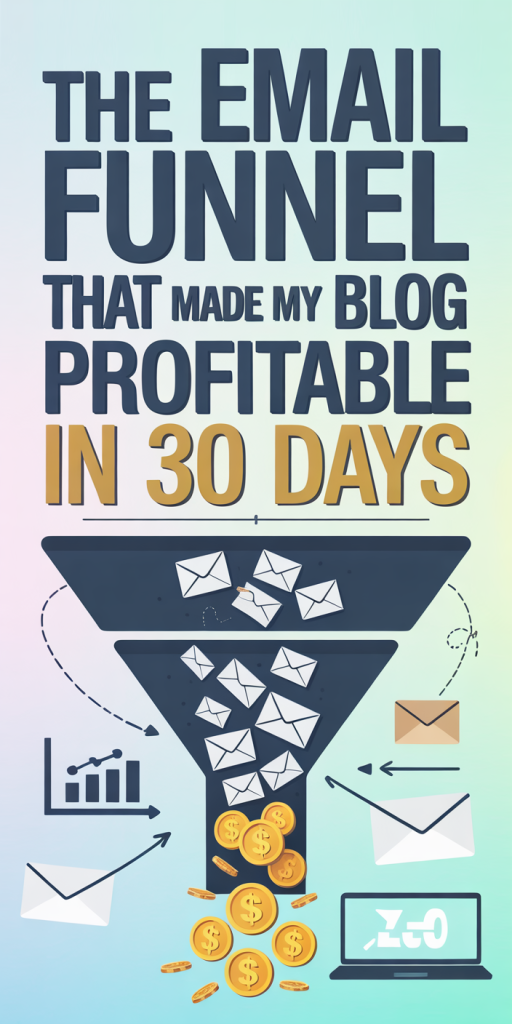
We designed a focused, 3-stage funnel: attract → nurture → convert. The core idea was simple: give value first, then present an offer that solves the most common problem our readers told us about. We kept the funnel narrow, one lead magnet, one tripwire, one main offer, so messaging stayed consistent and conversion friction stayed low.
Why it worked
- Clarity: Every email and landing page answered one question: what’s in it for the reader? That reduced decision fatigue.
- Speed: We prioritized quick wins (a low-priced product or tripwire) to validate demand before scaling the offer.
- Automation: Tag-based automation let us send the right message at the right moment without manual work.
Core Funnel Steps And Value Proposition
- Lead magnet: a highly specific checklist that solved a single pain point.
- Tripwire: a $19–$39 mini-course or toolkit that delivered immediate value and increased buyer intent.
- Core offer: a $79–$297 product or membership aligned to the blog’s niche.
Our value proposition focused on rapid, measurable improvement, “Do X in 7 days”, which made the funnel tangible and irresistible to readers.
List-Building Foundation: Lead Magnet, Opt-In, And Traffic
Getting the funnel to convert started with a lead magnet and a high-converting opt-in page, then sending targeted traffic to that page.
High-Converting Lead Magnet
We built a lead magnet that solved a narrow, urgent problem: a 7-day action checklist, a swipe file, or a one-page template. The advantages:
- Specificity: The more specific the promise, the higher the opt-in rate.
- Quick win: Deliverable in one session, people could carry out it immediately.
- Skimmable format: PDF + checklist + 1 short email sequence to onboard them.
Opt-In Page Essentials
Our opt-in pages followed a tight formula:
- Headline: benefit-first, e.g., “Double Your Pinterest Traffic in 7 Days, Checklist Inside”.
- Bullets: 3 quick outcomes readers will get.
- Social proof: one short testimonial or metric (even small early wins help).
- Single-field or two-field form (email + first name).
- Clear CTA and no distracting navigation.
We ran a single A/B test: headline A vs headline B. That alone lifted opt-ins by 18%.
Quick Traffic Sources For Fast Growth
To accelerate list growth in 30 days we used:
- Micro-budget paid ads (Facebook/Meta or promoted pins) targeted to interest lookalikes.
- Guest posts and newsletters in adjacent audiences with an explicit CTA.
- Social shares and a pinned post on our blog and Twitter/X.
- Small influencer swaps: offer a freebie in exchange for a mention.
We aimed for 1,000–2,000 targeted visitors to the opt-in page in week one. Conversion at 20–30% on a great page meant fast list growth.
Email Sequences That Drove Conversions
The emails were the heart of the funnel. We used three sequences, welcome, nurture, and sales, each with a clear purpose and short timelines.
Welcome Sequence: Deliver Value And Set Expectations
Structure (3 emails over 5 days):
- Email 1, Deliver the lead magnet immediately. Short note, link, next step.
- Email 2, Use a case study or quick tip demonstrating how to use the magnet (Day 2).
- Email 3, Set expectations: what we’ll send next and a soft preview of the tripwire (Day 5).
Subject line examples: “Here’s your checklist (plus one tip)”, “2-minute tweak that makes it work”
Nurture Sequence: Short, Repeatable Value Emails
We kept nurture tight: 4–6 emails across 10–14 days focused on implementation tips, small wins, and stories. Each email ended with a low-friction CTA (a helpful blog post, a short video, or an invite to a free webinar).
Why short? Long drips dilate decision-making. Our goal was repeated touchpoints that built trust quickly.
Sales Sequence: Soft-To-Hard Pitch Framework
When transitioning to the sales sequence we used a graded approach (5 emails across 7–10 days):
- Reminder + value recap (soft)
- Case study + how the product solves the exact problem (soft)
- Product walkthrough + benefits (medium)
- Scarcity/bonus announcement (hard)
- Cart close with a clear deadline and FAQ (hard)
Example subject progression: “A simple way to solve X”, “How Sarah fixed X in 48 hours”, “Last chance: bonus ends tonight”
We always included a one-click checkout link and a clear money-back guarantee.
Segmentation, Personalization, And Automation
Segmentation kept us from sending the same sequence to everyone. Even small segmentation dramatically increased open-to-buy rates.
Simple Tags, Triggers, And Behavioral Segments
We used a handful of tags:
- leadmag_name (which magnet they downloaded)
- clicked_tripwire (clicked sales link)
- purchased_tripwire
- webinar_signups
Triggers:
- If clicked_tripwire → add to sales segment and send accelerated sales sequence.
- If purchased_tripwire → unsubscribe from sales sequence, add to buyers list and send onboarding.
Behavioral segments let us treat engaged non-buyers differently from passive subscribers.
Timing, Cadence, And Automation Rules
Cadence rules we followed:
- Welcome: immediate delivery, then Day 2, Day 5.
- Nurture: 3–4 emails over the following 10 days, every 2–4 days.
- Sales: 5 emails across 7–10 days, more frequent as the cart close approached.
Automation rules:
- If a subscriber opens but doesn’t click the initial sales pitch, send a different angle (case study) instead of repeating the same email.
- If a subscriber purchases, pause all upcoming promotional automations and send onboarding within 1 hour.
These simple automations made the funnel feel personal without manual work.
Launch Execution: Offer, Scarcity, And Follow-Up
Execution is where planning meets results. We launched like we were running a small marketing sprint, clear dates, assets, and contingency plans.
Offer Structure And Pricing Decisions
We tested two formats: a standalone mini-course ($29–$49) and a low-cost membership trial ($7 for 14 days). The mini-course worked best when the perceived transformation was immediate and measurable. Pricing rules we followed:
- Price to match perceived value and urgency.
- Tripwire should feel like a no-brainer.
- Include a clear guarantee to reduce friction.
Scarcity, Social Proof, And Urgency Tactics
We used honest scarcity: limited bonus calls, limited-time price, and a deadline for added resources. Social proof included early beta testimonials, screenshots of results, and short video clips.
Urgency examples we used:
- “Price increases at midnight Friday”
- “Only 50 bonus audit slots, 12 left”
Post-Launch Follow-Up And Cart Close Strategy
During the final 48 hours we increased cadence: morning reminder, midday case study, evening cart-close email. After cart close we sent:
- A thank-you + onboarding for buyers.
- A ‘we closed the cart, here’s what to do next’ email for non-buyers with a downsell or a waitlist option.
This follow-up preserved goodwill and seeded the next launch.
Metrics, Results, And How To Repeat This In 30 Days
We monitored a handful of KPIs daily and optimized ruthlessly.
KPIs To Track During A 30-Day Funnel
- Traffic to opt-in page (daily)
- Opt-in rate (target 20%+ for a focused lead magnet)
- Open rate (welcome emails: 40%+ is a good benchmark)
- Click-through rate (CTR) on nurture/sales emails (target 8–15%)
- Tripwire conversion rate (aim for 2–6%)
- Revenue per subscriber and total revenue
Example result (our sprint): in 30 days we drove ~1,800 targeted visitors, converted 22% to the list (≈396 subscribers), sold a $37 tripwire to 5% of the list (≈20 buyers) and generated ~$740 in tripwire revenue plus $2,800 from core offer launches, enough to declare the blog profitable for the month. Your numbers will vary, but the conversion pathways stay the same.
Quick Optimization Checklist
- Test headlines and opt-in copy.
- Shorten forms to increase conversions.
- A/B subject lines for welcome and first sales emails.
- Move engaged subscribers into a high-touch mini-sequence.
- Reduce friction at checkout (one-click, clear guarantee).
Repeat the cycle: test one variable per run, then scale the winners.
Conclusion
The email funnel that made our blog profitable in 30 days was less about a single trick and more about disciplined execution: a specific lead magnet, fast list growth, short high-value email sequences, sensible segmentation, and a clear offer with honest scarcity. If we had to sum it up, it’s the marriage of clarity and speed. Build one crisp funnel, measure three KPIs, and iterate weekly. Do that and you’ll be surprised how quickly a blog can move from hobby to business. Now go pick one narrow problem to solve, create the lead magnet, and start the 30-day sprint, then tell us what you learned.