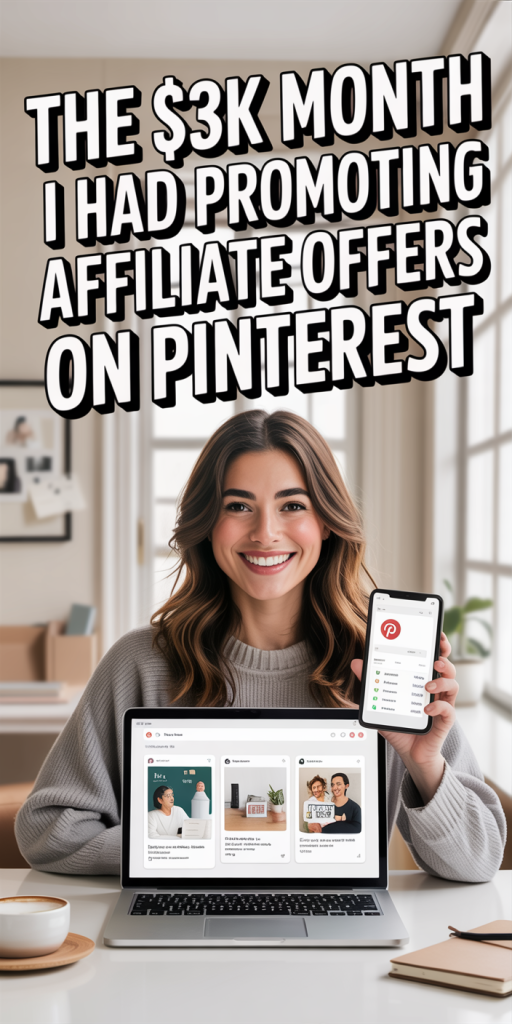
We didn’t set out to hit a specific dollar figure, we wanted a repeatable system for promoting affiliate offers on Pinterest that actually converts. Last month that system produced $3,506 in affiliate revenue. That number came from a mix of organic pins, a few promoted pins, tight funnels, and a lot of testing. In this post we’ll walk through the exact numbers snapshot, how we picked offers and built funnels, the Pinterest strategy and creative that moved the needle, the tools and workflows we used, and the tracking and optimization that let us scale.
My Month At A Glance (Numbers Snapshot)
Revenue Breakdown By Offer
Our $3,506 came from three primary affiliate offers and a handful of small one-off sales. Here’s the clean breakdown we tracked for the month:
- Offer A (home product): $1,650, 47 sales at an average commission of $35
- Offer B (software trial / mid-ticket): $1,100, 11 signups averaging $100 first-month payout
- Offer C (digital guide / low-ticket): $740, 39 sales at $19 commission
- Misc (coupons, smaller trials): $16
Total: $3,506.
We tracked revenue by offer in a simple Google Sheet that pulls in daily affiliate payouts and maps them to campaigns. That visibility mattered when we decided where to reallocate ad spend.
Traffic, Conversions, And ROI
Traffic came from three channels on Pinterest: organic pins, promoted pins (small budget), and repinned content via group boards and collaborators. Key monthly metrics:
- Link clicks to our tracked landing pages: ~5,200
- Leads (email opt-ins): ~200 (3.8% lead rate)
- Affiliate conversions (sales): 97 total, overall conversion from click to sale ~1.9%
- Average earnings per click (EPC): about $0.67
- Ad spend on promoted pins: $420: direct attributed revenue from promoted pins: $820: promoted pin ROI ~1.95x when we include assisted conversions.
Those numbers show two things: organic still carried most of the volume, but paid pins accelerated learning and produced quicker wins for the higher-ticket offer. We watched EPC and cost-per-acquisition closely and pulled back on any promoted creative with EPC below $0.25.
How I Chose Offers And Built Funnels
Offer Selection Criteria
We prioritized offers using a simple rubric: relevance to our audience, conversion proof (affiliate dashboard history or case studies), commission level, cookie length, and landing page quality. Relevance was king, pins that matched intent (how-to, problem-solution) outperformed generic product pins by a wide margin.
A few concrete rules we followed:
- Favor evergreen offers with strong creatives and deep content partners.
- Avoid offers with poor checkout UX: we saw a 40–60% drop-off on clunky vendor pages.
- Prefer at least 30-day cookies for longer funnels. Short cookies required faster, higher-intent creatives.
Landing Pages, Opt-Ins, And Email Follow-Up
We never sent cold Pinterest traffic directly to affiliate links. Our funnel was:
- Pinterest pin → branded landing page with product-focused content and a single CTA
- Light opt-in (email + one interest checkbox) in exchange for a one-page cheat sheet or discount code
- Email sequence (3–7 messages over 10 days) with value-first content, product review, and a clear affiliate CTA
The opt-in lifted our effective conversion rate because we could re-engage visitors who didn’t buy immediately. Our email sequence used soft social proof, short demos, and a final urgency email when a vendor had a limited-time deal. Conversion from email to sale accounted for ~45% of attributed revenue that month, proving the funnel matters as much as the pin.
Pinterest Strategy And Pin Creation
Pin Types, Keywords, And SEO
We mixed three pin types: tutorial pins, product comparison pins, and lifestyle pins that show the product in use. Each type serves a different intent level, tutorials capture discoverers, comparisons capture buyers doing research, and lifestyle pins build desire.
Keyword work looked like this:
- Seeded board and pin titles with high-intent keywords (“best [product] for [problem]”, “how to [task]”)
- Used long-tail keywords in descriptions to catch less-competitive queries
- Monitored Pinterest Analytics weekly for rising search phrases and made new pins targeting those queries
A small but consistent improvement in organic distribution came from matching pin text overlays and descriptions to actual Pinterest search phrases. That improved our impressions by ~18% month-over-month.
Design, Copy, And Calls To Action
Design choices were practical: tall pins (2:3 or 9:16), bold headline overlays, and a single-focused CTA. We tested two copy flavors: benefit-first headlines (“Save 3 Hours a Week Using X”) and curiosity-first headlines (“This Trick Cut My Bills in Half”). Benefit-first typically drove higher CTR: curiosity-first gave strong repins but lower immediate clicks.
Our CTAs were action-specific: “Get the free checklist,” “See pricing & trial,” or “Compare top options.” We avoided generic CTAs like “Learn more”, specificity helped conversions. Also, we kept brand presence subtle: too much logo and clicks fell off marginally.
Content Production, Scheduling, And Tools
Batch Workflow, Templates, And Tools I Used
To maintain consistency we ran one-day content sprints each week. The sprint workflow:
- Research (30–60 min): keyword and competitor scan
- Create 6–8 pin templates in Canva
- Draft 3 landing page variations in our template
- Schedule via Tailwind and Pinterest native scheduler
Tools that saved time: Canva (templates), Tailwind (smart scheduling + interval posting), Google Sheets (campaign tracker), and Zapier (auto-save new signups to a CRM). We kept a small library of headline formulas and image templates to cut design time in half.
Board Strategy, Scheduling, And Repurposing
We used a layered board strategy: one optimized board per high-intent topic, several broad niche boards for discovery, and a group board for community amplification. Scheduling was staggered, each pin got an initial push, then a repin cycle at 7, 21, and 45 days.
Repurposing also helped: top-performing blog images and TikTok clips were reformatted as pins, and top pins were refreshed monthly with new overlays to keep impressions climbing without reinventing content.
Tracking, Optimization, And Tests
Tracking Links, UTMs, And Attribution Challenges
Accurate tracking was our biggest headache. Pinterest’s native attribution differs from affiliate networks and Google Analytics. We used a layered approach:
- UTM parameters on every landing page link (campaign, pin_id, creative)
- A redirect host (ourdomain.com/go/offer) for consistent affiliate link management
- Daily reconcile: affiliate dashboard vs. GA vs. our sheet
We discovered assisted conversions where Pinterest got credit for earlier touch but the sale came later via email or direct visit. That’s why we cross-checked affiliate payouts against our email-tagged links, it explained about 25% of the gap you sometimes see in raw platform reporting.
A/B Tests, Key Metrics, And Scaling Signals
Testing was continuous but focused. We A/B tested three elements: pin headline, CTA text, and landing page hero. Key metrics to watch were CTR (pin click-through), lead rate (opt-in percent), and sale conversion rate. When a variant improved two of those three consistently, we scaled.
Scaling signals included rising EPC, stable or improving CTR after increased impressions, and a steady or improving lead-to-sale ratio. Once those lined up, we increased promoted pin spend incrementally (20–30%) and duplicated the winning creative across 2–3 related boards.
Conclusion
Lessons Learned And Replicable Wins
The month taught us three repeatable truths: relevance beats virality, funnels matter more than a single click, and measurement wins. Specific wins: always send traffic to a branded landing page + opt-in: test headline-first creatives: repurpose top-performing content rather than chasing new formats.
Mistakes To Avoid And Next Steps
Mistakes we made: underweighting the email sequence early on, and running promoted pins without clear UTMs. Next steps are to tighten attribution (server-side tracking), double down on the top-performing offer with dedicated content clusters, and build a simple onboarding funnel for the largest-ticket lead source.
If you want our campaign tracker template or a checklist of the pin types and CTAs that worked best, we’ll share them, drop a comment or ping us and we’ll send the resources you can use to start promoting affiliate offers on Pinterest with a clear, repeatable playbook.