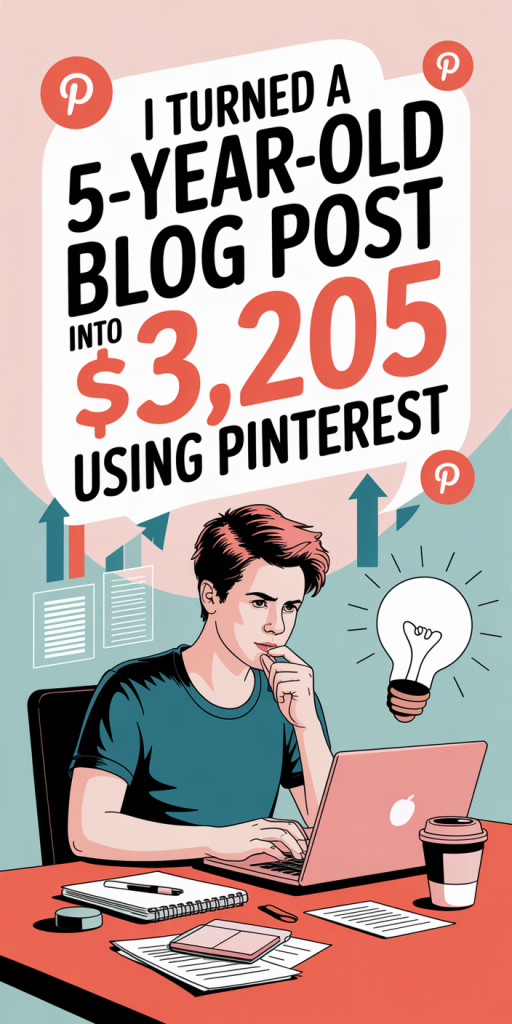
We stumbled back across a five-year-old post last winter and, instead of archiving it, decided to run a targeted Pinterest campaign. The result surprised us: in 60 days that single post generated $3,205. That wasn’t luck, it was a mix of careful content updates, intentional pin creative, and a clean traffic-to-conversion funnel. In this post we’ll show exactly why we picked that post, what we changed, the Pinterest tactics we used, how we executed the campaign, and the real metrics behind the $3,205.
Why I Revisited A 5-Year-Old Post
Old posts are often low-hanging fruit: they already have search equity, internal links, and a bit of domain trust. We revisit posts when we see three things: evergreen intent, a clear monetization path, and historical traffic that’s plateaued or declining.
Criteria For Choosing The Post
We used four criteria to pick the winner:
- Evergreen topic: The post answered a timeless question that people still search for. Seasonal pieces rarely make the list.
- Existing baseline traffic: The post was receiving steady organic visits (roughly 400–600 sessions/month), which meant a successful refresh could scale quickly.
- Monetization fit: The content naturally aligned with affiliate products and a small digital offer we already had in the funnel.
- Low competition on distribution platforms: The post’s titles and imagery were ripe for repurposing into Pinterest-friendly pins.
That combo made the decision simple: this post required a refresh more than a rewrite, and it had direct ways to earn.
How I Prepared The Post For Repurposing
Updating a post for Pinterest traffic isn’t just about adding prettier images. We treated this as a mini product launch: content polish, technical fixes, and monetization upgrades.
Content Updates And On-Page SEO
First, we rewrote the introduction and H2s to reflect current language people use on Pinterest. We:
- Tightened the headline and added a Pinterest-friendly subtitle.
- Broke dense paragraphs into scannable chunks and added clear, actionable steps and visuals (screenshots and a simple infographic).
- Updated statistics and any out-of-date links.
- Improved on-page SEO: optimized the meta title, description, and added long-tail keywords we found in Pinterest search suggestions.
These changes improved time on page and made the article easier to digest for traffic coming from a visual platform.
Monetization Enhancements And Offer Placement
We layered three monetization points, spaced logically throughout the article so each had its own traffic moment:
- Contextual affiliate links placed next to relevant how-to steps (no deceptive placement).
- A compact, targeted opt-in (lead magnet) halfway down the page to capture interested readers.
- A short product pitch at the end linking to a low-ticket digital guide in our email funnel.
We also ensured the affiliate links opened in new tabs, used clear disclosure language, and trackable UTM parameters so every click and sale could be attributed to Pinterest.
Pinterest Strategy I Used
Pinterest is a search engine disguised as a social network. Our strategy leaned into that: keyword-led pins, diverse creatives, and purposeful board organization.
Pin Types And Creative Concepts
We created three pin types for A/B testing:
- Standard vertical pins (2:3) with bold text overlays and a single clear promise.
- Carousel pins highlighting a step-by-step micro-tutorial pulled from the post.
- Video pins (15–30 seconds) showing the quickest tip in action.
Creative notes: high contrast, branded accent color, and a consistent template so pins looked related. We also used one “lifestyle” image pin for broader reach.
Keyword Research And Pin SEO
We treated Pinterest like keyword research: we exported Pinterest search suggestions, combined them with related Google long-tail queries, and mapped top 10 keywords to pin titles and descriptions. Each pin had:
- A keyword-rich title (not stuffed).
- A 2–3 sentence description using variations of the target phrase.
- Hashtags for the most relevant 2–3 keyword phrases.
This made our pins discoverable in both home feed and search results.
Board Organization And Promotion Tactics
We organized boards by intent (e.g., “How-To,” “Product Picks,” “Quick Wins”) and saved pins to 3–5 relevant group boards and our own boards. We staggered pin publishing across several boards to avoid looking spammy and used a mix of fresh pins and repins of the same post with alternate creatives.
Execution: Pin Creation, Scheduling, And Post Promotion
Execution is where strategy meets discipline. We used a repeatable process to scale without burning time.
Designing High-Converting Pins
We prioritized clarity: pins answered the question at a glance. Each design included:
- A one-line benefit (e.g., “Make X in 10 minutes”).
- A small logo for brand consistency.
- A contrasting CTA like “Read This” or “Get the Checklist.”
We tested two CTAs and three color variations per creative to see which combination produced higher CTR.
Scheduling Frequency And Timing
We scheduled 12 unique pins for this single post across 60 days, roughly a new pin every 5 days, and re-pinned high-performers weekly. Timing was based on our audience’s engagement windows (evenings and weekends). We used a scheduler that allowed repeat pins with different descriptions so Pinterest treated them as fresh content.
Cross-Promotion And Traffic Funnels
On the post itself we nudged readers into a simple funnel: opt-in → short email sequence → soft sell. We also cross-promoted the post in a related Instagram Story and a small Facebook group to kickstart engagement, but the bulk of traffic came from Pinterest.
Results And Revenue Breakdown
Sixty days after launch the post generated $3,205 in revenue. Here’s the transparent breakdown and the key traffic metrics that produced it.
Traffic, Clickthrough, And Conversion Metrics
- Pinterest performance (60 days): ~320,000 impressions and 11,200 clicks to the post (≈3.5% pin CTR).
- On-site traffic: 11,200 sessions and ~13,440 pageviews (average pages/session 1.2).
- Engagement: average time on page ~3:20, bounce rate ~57%.
- Conversion benchmarks from that traffic: email opt-in rate ~2%, affiliate purchase conversion ~0.36% (on-site), and email funnel conversion to paid product ~7% among new subscribers.
Those conversion figures combined with the post’s monetization mix produced the revenue below.
Itemized Revenue Sources And Timeline
- Affiliate commissions: $1,420, roughly 40 purchases at an average commission of about $35. Most affiliate sales came from contextual links in the how-to steps.
- Display ads: $640, ad revenue from increased pageviews (we run a premium ad network, so RPM was above typical blog averages).
- Email funnel sales: $1,145, 16 purchases from our low-ticket guide promoted in the post’s email sequence.
Timeline: results ramped quickly, most revenue came in the first 30–45 days once the pins gained traction: the second 15 days were steady, and we continued to see residual revenue beyond the 60-day window.
Step-By-Step Checklist To Replicate
This checklist distills our process into actionable steps you can start today.
Quick Action Steps To Start Today
- Pick a post with evergreen intent and an obvious monetization path.
- Update the content: tighten copy, add visuals, and fix SEO elements (meta title, description, headings).
- Add or optimize monetization: affiliate links, opt-in, and a low-ticket offer.
- Create 8–12 pin creatives (vertical images, carousel, video). Use a consistent template.
- Do Pinterest keyword research and write keyword-rich pin titles and descriptions.
- Schedule pins spaced out over 60 days, saving each to 3–5 relevant boards.
- Add UTM parameters to track traffic source and conversions.
- Launch a short email sequence for new opt-ins to monetize traffic beyond the first visit.
Metrics To Track And Optimize
- Pinterest impressions, saves, and click-throughs (pin-level).
- Sessions, pageviews, time on page, and bounce rate (post-level).
- Email opt-in rate and open/click rates for the welcome sequence.
- Affiliate conversion rate and average order value.
- RPM or ad revenue per thousand pageviews.
Optimize iteratively: double down on pin creatives that drive CTR, tweak copy or placement of offers on the page, and test the email sequence subject lines and CTAs.
Conclusion
Turning a five-year-old post into $3,205 on Pinterest wasn’t a one-off miracle, it was a repeatable playbook. We combined targeted content updates, multiple monetization touchpoints, keyword-led pin SEO, and disciplined scheduling. If you’ve got a handful of evergreen posts collecting dust, pick the one with the clearest monetization path, make it Pinterest-ready, and treat promotion like a mini launch. With the right creatives and tracking, an old post can pay like new content.