Small sign-up bonuses—think a $1 or $3 welcome credit—show up everywhere: pop-up banners, app stores, and friends’ referral messages. They feel like free money. But “free” rarely is. This guide treats those tiny rewards as real economic choices: how much time and personal information do they cost, what hoops will you jump through to get the payout, and when is it smarter to ignore them? You’ll get a practical decision framework, a quick ROI method based on time-to-value, a compact checklist, and a step-by-step redemption plan so you can decide fast and, if you proceed, extract the most value with the least hassle.
Why tiny sign-up bonuses attract you — psychology and tradeoffs
A small cash or credit reward triggers several psychological responses that apps and services count on. First, the “easy win” feeling: collecting something small with minimal effort feels satisfying and signals a low-risk gain. Second, social proof and scarcity—limited-time or referral-only bonuses make the offer seem urgent and exclusive. Third, loss aversion: once you see the offer you feel like you’d be losing something if you don’t grab it.
Those reactions push many people to sign up for dozens of apps. The real-world tradeoffs, however, are often buried:
- Time: account creation, email or phone verification, linking a payment method, uploading receipts, or completing a qualifying purchase can add up.
- Data and privacy: many apps request or require personal info (phone number, mailing address, IRS ID for larger amounts, or the right to read your purchase history).
- Ongoing friction: some bonuses require you to reach a payout threshold or keep the app installed to receive credits.
- Mental clutter: dozens of low-value accounts increase the chance of missed communications, forgotten passwords, and eventual data cleanups.
If you want to decide fast, treat each bonus as a tiny project: what are the concrete steps to get the $1, how long will they take, what personal data are you giving up, and is any spending required? Below you’ll find the mechanics to watch and a repeatable way to calculate the true value.
Ready to turn an idea into practical income?
Common mechanics of cashback and rebate app sign-up rewards
Different apps use similar building blocks for sign-up incentives. Knowing the common mechanics helps you spot the hidden costs and estimate how long actual redemption takes.
H3: Welcome bonuses
These are credits given for signing up and sometimes completing a first action (e.g., make any purchase, scan one receipt, or link a card). They can be instant or contingent on verification. Watch for a clause that says the credit posts only after X days.
H3: Referral credits
You might get a bonus only when a friend signs up and also completes qualifying actions. Referral bonuses often require both parties to meet conditions; the referrer’s reward might not activate until the referee finishes a purchase.
H3: Minimum thresholds and payout rules
Many apps accumulate cashback or points and only allow withdrawal when you hit a minimum balance (e.g., $5, $10). That means a $1 sign-up bonus may sit unused until you top up the account.
H3: First-transaction requirements
Some bonuses require a purchase through the app or a linked card. The required purchase can be a specific category, minimum amount, or a one-time transaction. Returns or canceled purchases typically nullify the bonus.
H3: Expiration windows and reversals
Bonuses can expire if not redeemed within a short window, or they can be reversed if the platform detects irregular activity. Make sure the offer’s expiry and reversal terms aren’t stronger than the apparent reward.
How to evaluate a sign-up bonus: time-to-value and simple ROI
Instead of asking “Is $1 worth it?” ask “What is the net value per hour of the time I’ll spend, after accounting for fees, required purchases, and privacy cost?” Here’s a systematic way to evaluate a tiny sign-up reward in under five minutes.
H3: Step A — Map the concrete steps
Write down the specific actions required to earn the bonus. Typical steps include:
- Download app or visit website
- Create account (email, password)
- Phone verification (SMS)
- Link a card or payment account
- Complete a qualifying purchase or upload a receipt
- Wait for processing and payout
Estimate minutes for each. Example: download (2), account setup (5), verification (3), link card (4), make purchase (time varies), upload receipt (2) = base time 16 minutes plus purchase time.
H3: Step B — Assign a time cost and compute time-to-value
Convert minutes into hours and choose an opportunity cost for your time (your hourly value). For most people a fair personal time value is between $10–$40/hour depending on what else you could be doing. If you prefer not to assign a dollar value to your time, you can use minutes as the key metric: is this under 15 minutes of true work?
Simple formula:
Net payout = bonus amount − direct monetary costs (purchase net, fees)
Time-spent (hours) = total estimated minutes ÷ 60
Effective dollars per hour = Net payout ÷ Time-spent
Example: $1 bonus, 20 minutes total, no purchase or fee
Time-spent = 0.333 hours → $1 ÷ 0.333 ≈ $3.00/hour. For many, $3/hr is not worth the time; for others it is acceptable for micro tasks.
H3: Step C — Account for data and privacy cost
Personal data has value even if not monetized directly in the short term. Identify the types of data requested:
- Email and phone: used for marketing and SMS campaigns.
- Payment card details: can enable tracking of purchases or auto-charges.
- Receipts or purchase history: reveals shopping patterns.
- Identity information: name, address, SSN (rare for small bonuses but sometimes required for larger payouts).
How to factor this in: if you assign a conservative perceived cost to privacy—say $2–$10 for unwanted marketing and tracking—you can subtract that from the bonus before computing dollars-per-hour. If you strongly dislike marketing emails or targeted ads, treat privacy cost as a deal-breaker unless the time-to-value is very favorable.
H3: Step D — Include financial costs and friction
Watch for these:
- Payout thresholds: if the bonus is $1 but you cannot withdraw unless you have $5, you may need to do additional work.
- Fees: some payout methods (gift card conversions, PayPal instant transfer) may include fees.
- Required purchases: if you must spend money you wouldn’t otherwise, subtract the net cost of the purchase when you calculate net payout.
- Linked accounts: linking a bank or card can trigger account verification holds.
H3: Step E — Redemption friction and timeline
Consider how soon you’ll actually get the cash:
- Instant credit vs. 7–30 day processing.
- Requirement to keep funds in account a long time before withdrawal.
- Payout method availability in your country and whether it supports your preferred withdrawal (PayPal, bank transfer, check, gift card).
If you’re being paid in gift cards, account for the utility of the gift card—many people value cash more flexibly than a specific retailer credit.
H3: Step F — Eligibility and terms
Check for geographic limits, device requirements (mobile-only), or previous-account restrictions. Many services prohibit multiple accounts or require unique devices. Violating those terms could result in blocked payouts and a loss of time.
Real examples of quick ROI math
Here are three realistic scenarios to illustrate how the math plays out in practice. Use these patterns to evaluate a live offer.
Scenario 1 — Low-friction $1 bonus (minimal time)
– Steps: install (2 min), create account (5 min), verify email (2 min). No purchase required. Credit posts immediately and PayPal payout available once you hit $1.
– Time-spent: 9 minutes → 0.15 hours
– Effective pay: $1 ÷ 0.15 ≈ $6.67/hour
– Verdict: If your personal time value is under ~$7/hour and you don’t mind the data sharing, it’s an acceptable quick win.
Scenario 2 — $1 bonus that requires $10 purchase
– Steps: install (2), signup (5), verify (2), make $10 purchase (10 minutes to buy), receipt upload (2), credit posts after 7 days.
– Time-spent: ~21 minutes → 0.35 hours
– Direct cost: $10 purchase (if you wouldn’t have made it otherwise)
– Net payout: $1 − $10 = −$9
– Effective pay: negative → skip unless the purchase serves another purpose you planned anyway.
Scenario 3 — $3 referral bonus but payout threshold is $10
– Steps: sign up (10 min), get $3 credited, cannot withdraw until $10 balance. You’d need to either refer others or earn additional cashback.
– Time-spent: 10 minutes for the signup
– Immediate usable value: $0 (until threshold met)
– Verdict: Only worth it if you intend to use the app regularly or can quickly meet the threshold through ordinary spending. Otherwise the $3 can become “sunk credit” you’ll never redeem.
Practical checklist — a fast decision framework
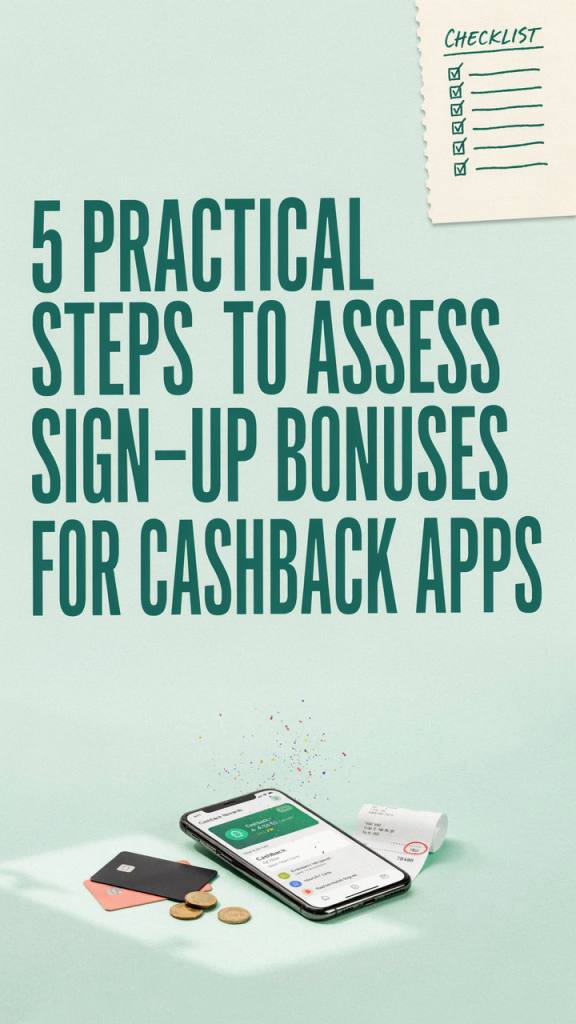
Use this one-minute checklist to decide quickly whether to sign up. Score each item as Yes (1 point) or No (0 points). Total the score and follow the recommendation.
Checklist items:
– No purchase required to receive the bonus
– Setup and redemption estimated under 15 minutes total
– Bonus can be withdrawn or used immediately (no high threshold)
– Payout method is acceptable to you (PayPal or bank transfer preferred)
– No sensitive personal information required (no SSN, no full transaction history access)
– Terms don’t require ongoing activity or subscription
– No device/account restrictions or requirement to create multiple accounts
Scoring guideline:
– 6–7 points: Go ahead — low friction and good net value for small rewards.
– 3–5 points: Consider it only if you have spare minutes and low privacy concerns.
– 0–2 points: Skip — likely not worth the time or risk.
A practical scoring example: if a $1 bonus nets you 5 points, but requires waiting 14 days and linking your card, you may still skip because the privacy and wait-time are problems. Use this checklist as a quick filter, not a final arbiter.
Step-by-step: a quick redemption plan if you decide to sign up
Follow these steps to maximize your chance of getting the bonus fast and cleanly:
- Read the bonus terms before creating the account
- Find the exact language describing the reward, qualifying actions, expiration, payout method, and minimums. Copy or screenshot it.
- Use a dedicated email alias
- Create an alias (e.g., yourname+cashback@example.com) to keep marketing emails separable from your main inbox. This keeps tracking manageable and makes it easier to find the confirmation email.
- Prepare verification details
- If the app asks for phone verification, be ready with your primary phone. For apps that require payment card linking, prepare a card you’re comfortable linking (consider a virtual card from your bank or card issuer if offered).
- Document timestamps and confirmation
- When you complete the qualifying action, take a screenshot showing the action and the timestamp. Keep the confirmation email or in-app message as proof.
- Watch for bonus posting windows
- Note the advertised timeframe (e.g., “credit posts within 7 business days”) and set a calendar reminder to check the balance after that window plus two extra days.
- Withdraw promptly
- If payout thresholds are low and you can withdraw, do so promptly. Leaving credits in accounts increases the chance of changes to terms, expiry, or losing access.
- Revoke unnecessary permissions and delete the app (if desired)
- If you signed up solely for the bonus, remove the app, unlink the card, and unsubscribe from marketing emails after the payout posts.
- Keep records for troubleshooting
- If the bonus does not post, having screenshots and timestamps makes it much easier to file a support ticket and escalate.
Quick log template you can copy into a notes app
– Offer title:
– Date/time account created:
– Email used:
– Phone used:
– Steps completed (with timestamps):
– Screenshot filenames:
– Expected bonus posting date:
– Actual posting date:
– Withdrawal date and method:
Common pitfalls and how to avoid them
- Hidden minimums trap: A $1 bonus that sits behind a $10 payout threshold may never be worth it. Always check minimum withdrawal balances first.
- Purchase you wouldn’t make: If the qualifying action requires spending on something you don’t need, don’t treat the bonus as a discount—treat it as marketing.
- Auto-subscriptions: Some offers require enabling an auto-renewal or subscription to qualify. Opt out of anything that has ongoing charges.
- Bonus reversals: If you return purchases used to qualify for the bonus, the platform may claw back the reward. Keep receipts and avoid returning qualifying items if you want to keep the bonus.
- Account duplication rules: Creating multiple accounts to grab multiple sign-up bonuses can break terms of service and lead to blocked payouts. Don’t risk it.
- Phone/SMS sprawl: Signing up with your mobile number can mean more marketing texts. Consider using voice-over-IP or an alternate number only if allowed by the platform and you accept the verification risks.
When to skip and when to pursue sign-up offers
Skip if:
– The effective dollars-per-hour is below your personal threshold and the task is not trivial.
– The offer requires sensitive personal data (full payment history, SSN).
– You must make purchases you wouldn’t otherwise make.
– The bonus is locked behind a high withdrawal threshold or lengthy processing windows.
– It introduces risk of recurring charges or subscription traps.
Pursue if:
– The time-to-value is under ~15 minutes and you value even small returns for spare minutes.
– No purchase is required and payout methods are immediate and acceptable.
– You were already planning to use the app or the service is useful beyond the bonus.
– The app uses minimal permissions and doesn’t request sensitive identity data.
– Referral stacking or legitimate friends can help you quickly meet payout thresholds.
Other realistic downsides and edge cases to consider
- Tax considerations: For very small amounts you can ignore taxes, but if you complete many offers and accumulate larger sums, some platforms may report payments to tax authorities. Keep an eye on annual totals.
- Identity verification leaps: Some services escalate verification steps unexpectedly if they detect “suspicious” behavior, asking for more documents. Prepare to decline if you’re not comfortable providing extra IDs.
- Customer support friction: If a bonus fails to post, resolution may require back-and-forth with support. Decide whether you want to spend additional minutes on disputes.
- Device-level tracking: Some apps request access to device-level identifiers (advertising IDs) or permission to track app activity. If you value privacy, deny permissions when possible.
- Long-term inbox pollution: Multiple small sign-ups can flood your email and phone with offers. Use rules/filters right away to avoid that noise.
A quick cheat sheet you can print
Use this one-page checklist to evaluate and act quickly.
Before you sign up:
– Is no-purchase required? Y/N
– Estimated setup time (minutes): __
– Withdrawal threshold: $__
– Payout method: PayPal / Bank / Gift card / Other
– Personal data required: Email / Phone / Card / SSN / Purchase history
– Expiry on bonus: __ days
– Ongoing subscription required? Y/N
Decision rule:
– If no-purchase + setup ≤ 15 minutes + withdrawal threshold ≤ bonus × 5 + payout method acceptable + no SSN: Accept.
– Otherwise: Likely skip.
Final tips for managing sign-up bonuses over time
- Batch them: If you have a few spare minutes, do multiple low-friction sign-ups in one session. That reduces the overhead per bonus.
- Keep a master list: Track which apps you created accounts with and the email used. This helps you purge accounts later and manage marketing emails.
- Use a password manager: Don’t create multiple weak passwords. A password manager stores credentials securely and saves time.
- Treat privacy like currency: For rewards under a few dollars, don’t trade sensitive info. If an offer looks valuable but asks for too much, walk away.
- Consider the “fun factor”: Some people enjoy chasing small wins; if that’s you and the time cost is low, the entertainment can be worth a few dollars.
Make the decision fast and move on
Tiny sign-up rewards can be worthwhile—but only if you treat them like microtasks with measurable time costs, privacy tradeoffs, and confirmed redemption paths. Use the quick checklist above, calculate the effective dollars per hour (or just compare minutes), and follow the redemption plan when you do proceed. For most people, the best approach is selective: go after the low-friction, low-data offers that post quickly and avoid anything that requires purchases, high thresholds, or sensitive personal data. That way you collect a few small wins without spending hours, cluttering your accounts, or compromising your privacy.