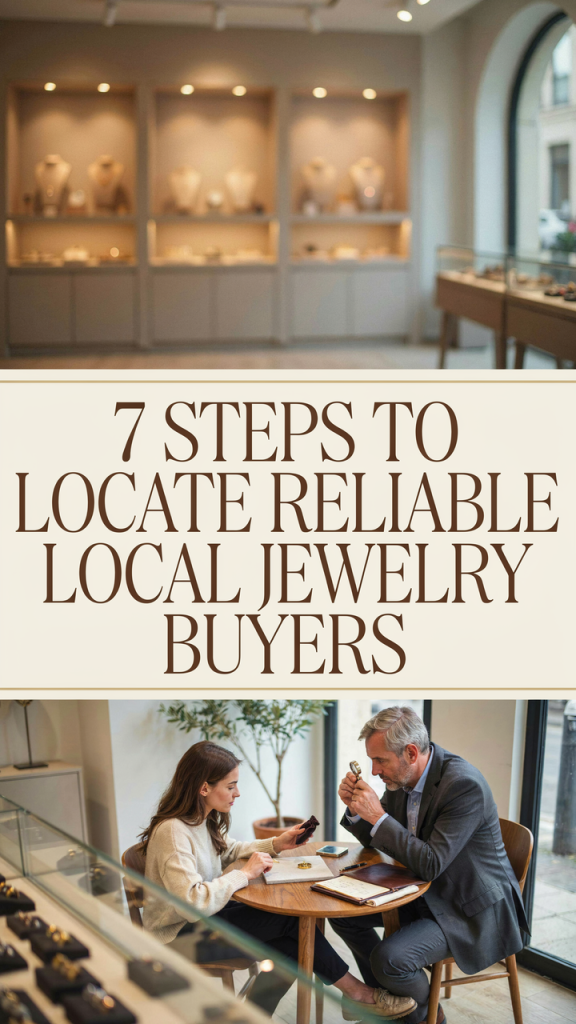
Selling unwanted or inherited jewelry locally can feel stressful: you want a fair price, quick payment, and the peace of mind that you’re not walking into a scam. The good news is that with a clear goal, a little preparation, and a simple plan to compare offers, you can confidently convert jewelry into cash while protecting your financial and personal safety. This guide walks you through choosing the right buyer, prepping items, estimating value, researching buyers, scheduling appointments, evaluating offers, negotiating, and completing a secure local sale.
Key Takeaways
Why sell your jewelry locally?
– Faster payment. Local buyers typically pay on the spot (cash or instant bank transfer) rather than holding an item while they list it online.
– Easier inspection. Buyers can look at the piece in person and you can watch testing and appraisal steps yourself.
– Lower shipping risk. No need to pack, insure, and ship valuable pieces through the mail.
– Greater flexibility. You can choose between selling outright, consigning, or using a short-term pawn loan.
If those benefits line up with your priorities, the rest of this article gives a complete workflow so you can walk into appointments prepared, compare offers fairly, and leave with the best outcome for your goals.
Ready to turn an idea into practical income?
Start with a goal: decide what matters most
Before you call buyers or polish a ring, clarify your priorities. Different buyers and sales paths match different goals. Spend 5–10 minutes answering the questions below to make choices easier.
Quick exercise (write answers or think through them)
– What is the most important outcome: immediate cash, the highest possible price, convenience, or privacy?
– How quickly do you need the money? (Today, within a week, or no rush?)
– Is the piece sentimental or a one-off item you want to separate from forever?
– Are you comfortable with strangers handling the jewelry or would you prefer established businesses with storefronts?
– Do you have documentation (appraisals, receipts, certificates)? If yes, how complete is it?
Decision rules based on answers
– Need cash today or this week → prioritize pawnshops, national buy-for-cash branches, or local jewelry stores that buy outright.
– Want highest price and can wait → consider consignment, estate buyers, or auction houses.
– Want privacy and low fuss → local jewelry store or specialized estate buyer may be best (avoid public auction or peer meetups).
– Have strong documentation or rare/collector pieces → target estate buyers, auction houses, or specialized collectors.
Types of local buyers and when each makes sense
Rather than a ranked list of stores, think in buyer categories. Each category serves different needs and typical offer levels vary.
Independent jewelry stores (local jewelers)
– What they do: Buy trade-ins, pre-owned jewelry, and scrap metal; some offer consignment or repairs.
– Typical profile: Professional storefronts, experienced staff, can perform testing and provide quick offers.
– When to use: You want a trusted local storefront, need fast payment, or the piece is retail-quality and desirable for resale.
– Typical pay level: Middle to high for attractive retail-ready pieces; lower for worn or damaged items.
Pawnshops
– What they do: Provide cash loans against items or buy outright; focus on fast liquidity.
– Typical profile: Cash-focused, wide variety of buyers, often willing to buy items in any condition.
– When to use: You need cash immediately and convenience matters more than getting top dollar.
– Typical pay level: Often lower than other buyers because they need margin and accept many items.
Specialized estate buyers / estate jewelers
– What they do: Handle jewelry from estates, rare pieces, designer or vintage items; can target collectors.
– Typical profile: More expertise on designer marks, vintage styles, and provenance.
– When to use: You have an antique, designer, or collectible piece that could fetch above scrap value.
– Typical pay level: Higher for collector/desirable items; lower for plain scrap.
Auction houses and local auctioneers
– What they do: Sell items to highest bidder at auction (in-person or timed online).
– Typical profile: Good for rare, historical, or designer pieces; fees and seller commissions apply.
– When to use: You want to maximize price and can wait for sale and payout schedule.
– Typical pay level: Can be highest for the right pieces; net proceeds depend on fees and final hammer price.
Consignment shops and boutiques
– What they do: Sell your item on your behalf; you receive a percentage after sale.
– Typical profile: Shops with steady foot traffic or boutique customer base; longer wait times.
– When to use: Expect a fair price without immediate need for cash and item is attractive to retail shoppers.
– Typical pay level: Moderate to high net price, after commission (which varies).
National buy-for-cash chains with local branches
– What they do: Large networks that buy jewelry for cash across many stores; consistent process.
– Typical profile: Uniform testing and pricing rules, convenient locations.
– When to use: You want quick, predictable process and broad consumer recognition.
– Typical pay level: Competitive for general pieces; may be lower than specialized buyers for designer items.
Peer-to-peer/local marketplaces and meetups
– What they do: Sell directly to another consumer via listing apps or local groups, or meet buyers in person.
– Typical profile: Potentially highest gross price if you find the right buyer; requires more legwork and safety precautions.
– When to use: You want market price and are comfortable handling classifieds and meeting strangers.
– Typical pay level: Potentially highest but with added time, safety risk, and effort required.
Pros and cons cheat-sheet
Use this quick checklist to visualize trade-offs when deciding which buyers to contact. For each category, tick boxes or circle the right fit for your priorities.
Criteria: Speed / Typical offer level / Fees/commissions / Paperwork required / Trust/risk
– Independent jeweler: Speed: fast; Offer: fair to good; Fees: low; Paperwork: moderate; Trust: moderate-high
– Pawnshop: Speed: immediate; Offer: low; Fees: none for outright sale; Paperwork: minimal; Trust: variable
– Estate buyer: Speed: moderate; Offer: good for collectibles; Fees: variable (often low); Paperwork: often more detailed; Trust: high for specialists
– Auction house: Speed: slow (weeks-months); Offer: potentially high; Fees: seller commissions and buyer premiums; Paperwork: formal consignment; Trust: high
– Consignment shop: Speed: slow; Offer: moderate-high after sale; Fees: commission; Paperwork: consignment agreement; Trust: moderate-high
– National cash chain: Speed: fast; Offer: fair; Fees: usually none; Paperwork: standard ID + sale form; Trust: moderate
– Peer-to-peer: Speed: flexible; Offer: variable (potentially high); Fees: low; Paperwork: informal unless you create a bill of sale; Trust: variable (use caution)
How to prepare your jewelry before you visit buyers
Getting organized and presenting pieces well raises your chances of a good offer and avoids wasted trips.
Gather documentation
– Receipts and original purchase paperwork.
– Appraisals (note appraisals are opinions of value at a point in time).
– Gemstone certificates (e.g., lab identification sheets).
– Any service records or repair receipts.
– Photographs showing the full item and any marks or damage.
Cleaning and presentation (do this gently)
– Light cleaning: Use a soft toothbrush, warm water, and mild dish soap. Rinse thoroughly and pat dry with a lint-free cloth.
– Avoid aggressive chemicals, ultrasonic cleaners, or steamers—these can loosen stones or damage delicate settings.
– Present jewelry on a clean, neutral background (white paper or cloth) to let the buyer inspect clearly.
– Bring a small box or pouch to keep items safe during transport.
Identify maker’s marks and karat stamps
– Look on clasps, inside rings, or on the back of pendants for small stamps: 10K, 14K, 18K, 750, 925 (silver), PLAT (platinum), maker logos, or hallmarks.
– If you can’t read a tiny mark, bring a phone photo with a close-up or a jeweler’s loupe if you have one.
What not to do
– Don’t attempt major repairs or resolder broken parts on your own.
– Don’t remove stones or attempt to replace them unless done professionally.
– Don’t bend settings to “make it look better” — this can reduce value and raise suspicion.
– Don’t rely on unsealed home appraisals or vague online claims; bring any professional paperwork you have.
How to estimate a realistic value yourself
Understanding the difference between value types prevents you accepting a bad offer or expecting unrealistic prices.
Three value types
– Retail replacement value: What it would cost to buy a similar piece new from a retailer. Often the highest number and not what buyers pay for secondhand items.
– Scrap/metal melt value: The intrinsic value of the precious metal and loose gem content if the piece is melted or broken down. This is a floor price many buyers won’t go much below.
– Resale/collector value: What a secondhand buyer will pay for a wearable, attractive, branded, or vintage piece. This typically sits between scrap and retail.
Simple ways to get a ballpark
– Weigh the item on a scale accurate to 0.1 grams or use a jeweler’s scale at a local store to learn gram weight.
– Calculate metal content: Gold content (grams) = weight * (karat / 24). For example, a 14K piece contains 14/24 of pure gold by weight. (Don’t need current prices to understand the fraction.)
– Look up current spot price per troy ounce (online) and convert (1 troy ounce ≈ 31.1035 grams) to estimate melt value. If this sounds technical, local buyers can test metal and show calculations—ask to see the math.
– For gemstones, determine if stones are natural vs. synthetic and whether they’re mounted. Loose certified stones command higher resale; small or low-quality stones mainly affect replacement or scrap value.
– Check completed local sales and auction results for similar items to estimate resale value (search recent listings or talk to estate buyers for comparable examples).
How to research local buyers
Finding trustworthy local buyers means combining online research with in-person checking. Use these practical steps.
Where to look online
– Business directories and review platforms for local listings.
– Better Business Bureau profiles (for complaints history and resolution).
– Local community forums and neighborhood apps for firsthand experiences.
– Social media pages for stores (recent posts and customer comments can show activity and reactions).
Credentials and vetting
– Look for memberships in local or national jewelers’ associations—this indicates a business invests in industry standards (but isn’t a guarantee).
– Verify licensing where required by municipal or state regulations (pawnshops often require specific licensing).
– Check whether the business posts clear buying policies on their website or in-store (ID requirements, payment methods, etc.).
Questions to ask by phone before an appointment
Use a short script to get basic answers and to decide whether a visit is worth scheduling:
Phone script (short):
– “Hi, I have a [describe: e.g., 14K gold ring with small diamond]. Do you buy jewelry outright or only consign?”
– “Do you buy items like mine on the spot, and what ID or paperwork do I need to bring?”
– “Can you give a rough range of what you’d pay for a [type] in good condition?”
– “If you need to test or appraise, do you do that in front of me and is there any fee?”
Verifying an appraiser’s qualifications
– Ask for the appraiser’s name, credentials, and whether they are independent or store-employed.
– Common reputable credentials include certifications from recognized gemological labs or appraisal organizations—ask which one and how long they have been appraising.
– If a store claims “certified appraisal,” ask to see the certificate and the appraiser’s written contact info.
– Beware of “internal” appraisals with no documentation; you can still use them for comparison but treat them cautiously.
Red flags and warning signs
Protect yourself by watching for these common red flags:
Payment and paperwork red flags
– Pressure to accept a “final” offer without allowing time to think or seek a second opinion.
– Insistence on nonstandard payment (e.g., cashier’s checks with no verification, promise of future wire transfer).
– Refusal to provide an itemized written offer, bill of sale, or receipt.
– Requests for your social security number or more personal information than a standard ID for a sale.
Behavioral and testing red flags
– Tester or appraiser refuses to perform visible tests (acid test, electronic testing) in front of you.
– Buyer offers a price far below your documented value and labels fees as “special” or “processing.”
– Seller claims “we can’t give more because of company policy” without explaining policy or providing written terms.
Safety red flags for meetups
– Buyer wants to meet in a secluded area, private home, or off-hours.
– Buyer pushes for a quick, private transaction without a receipt or witnesses.
If any red flag appears, pause. You can leave, ask for clarification in writing, or contact another buyer.
How to get multiple competitive offers — step-by-step plan
The best way to avoid giving away value is to get 3–4 offers from different buyer types and compare them apples-to-apples.
Step 1 — Choose your mix of buyers
– Pick 3–4 buyers from different categories. Example set:
1) Independent jeweler (storefront)
2) Pawnshop or national cash chain (fast cash)
3) Estate buyer or specialized vintage shop (expertise)
4) Local auction house or consignment shop (if applicable)
– If you have a rare or designer piece, swap in an auction house or specialized dealer.
Step 2 — Prepare consistent presentation
– Bring the same documentation, same cleaned piece, and present it the same way at each appointment so each buyer evaluates the exact same item.
– If a buyer requests additional photos ahead of an appointment, send clear, consistent images from multiple angles.
Step 3 — Schedule appointments strategically
– Book appointments close together in time: same day or within 48 hours. This prevents market fluctuation and preserves bargaining power.
– Keep earlier appointments less convenient (no commitment to sell), so you can use later offers as leverage.
Step 4 — Ask for written offers when possible
– Request a clear written estimate or offer that shows how they calculated value (metal testing, stone grading, percentage of retail).
– Script for asking: “Can you provide that offer in writing or an email so I can compare with other estimates?”
Step 5 — Compare offers properly
– Don’t focus only on the gross number. Consider net after fees or commissions, payment speed, safety, and paperwork clarity.
– If one buyer gives a higher price but wants a two-week hold or high commission, the immediate lower offer may be preferable depending on your priorities.
Messaging templates and phone scripts
Use these short templates to schedule or request preliminary estimates.
Phone appointment script:
“Hi, my name is [Name]. I have a [brief description: 14K gold, 1.2g ring with a small diamond]. Do you buy items like this? If so, can I book an appraisal appointment for [date/time]? I plan to get several local estimates.”
Email/DM request for photo estimate:
“Hello — I’m looking to get a quick estimate for a piece of jewelry before scheduling in-store. It’s a [brief description]. I’ve attached photos. Can you provide a ballpark range or confirm if you buy items like this? Thanks, [Name, phone number].”
Sample timeline for a same-week process
Day 0 (evening): Clean and photograph the item; gather documentation.
Day 1 (morning): Call and schedule three appointments for Day 2 (independent jeweler, pawnshop/national branch, estate buyer).
Day 2 (appointments): Visit buyers in scheduled order. Ask for written offers where possible. Keep notes of offer amounts, payment method, and any fees.
Day 2 (late afternoon): Compare offers and decide whether to accept or pursue consignment/auction route.
Day 3: If accepting an offer, complete paperwork, get payment, and confirm receipt. If pursuing auction/consignment, start consignment process.
Negotiating and completing the local sale
Negotiation is easier when you’ve done the prep work. Here’s a practical negotiation workflow and the paperwork to insist on.
Negotiation steps
– Ask the appraiser to explain how they arrived at their number (metal, stones, labor, resale margin). Request to see testing.
– If another offer is higher, mention it (without sharing the buyer’s name) and ask if they’ll match or make a firm counteroffer. Example: “I received an offer of $X from another shop. Can you match that?”
– Be polite, firm, and willing to walk away. A credible buyer will either improve the offer or explain why theirs is the best for that type of sale.
Paperwork to complete
– Bill of sale or purchase agreement: Names, date, item description, serial/maker marks, price paid, and payment method.
– Copy of ID for the seller if the buyer requires it—ask why it’s needed and ensure it’s recorded securely.
– Receipt showing taxes, if any, and the buyer’s business information (address, phone).
– Any consignment agreement should state the commission rate, duration, reserve price (if any), and how/when you will be paid.
Payment methods and safety
– Prefer instant payment methods: cash, immediate bank transfer, or verified cashier’s check after verification by bank (be cautious—verify with your own bank).
– If you accept a check, verify funds before handing over the piece; meet at your bank during business hours to deposit and confirm.
– Avoid complex delayed payment arrangements unless you understand terms and get them in writing.
After the sale: what to keep
– Keep a copy of the bill of sale and any paperwork for tax and legal records.
– If you sold inherited jewelry, consider whether you need to report the sale for estate or tax purposes—consult a professional if unsure.
Realistic downsides and cautions
– Net proceeds can be less than sentimental replacement value—retail price often exceeds resale price.
– Some buyers will offer low for damaged, heavily worn, or nonbranded items; don’t be surprised if offers are lower than expected.
– Auctions and consignment can take weeks or months before you see proceeds and include seller fees.
– Peer-to-peer selling can fetch more money but requires extra safety vigilance and time investment.
Final checklist before you leave for appointments
– Cleaned and photographed pieces.
– Documentation and certificates in hand.
– ID and contact information ready.
– Buyer appointment times confirmed and contact numbers saved.
– A plan for how many offers you’ll accept before choosing a sale method.
– A friend or family member who knows your plan and where you’re going (for safety).
Parting advice
Selling jewelry locally is a mix of preparation, clear priorities, and careful vetting. Decide whether speed, price, convenience, or privacy is most important, then follow a consistent workflow: prepare the piece and paperwork, get 3–4 varied offers close in time, request written estimates, and favor buyers who explain their pricing and provide clear documentation. With the right approach you’ll reduce risk, avoid common pitfalls, and get a fair outcome for your items.
If you’re unsure about an unusual or high-value piece, consider a formal independent appraisal before selling—this costs money but can pay off by helping you target the right buyer and set realistic expectations. Walk into your appointments prepared, and you’ll leave with confidence—and the cash you need.