Selling used board games is different from clearing out other household items. Games have variable demand (family staples, hobby titles, rare collector editions), many small parts, and condition matters more than you might think: a missing rulebook or bent card cuts value, while a complete, gently used Eurogame can fetch a good price. This guide gives a decision-first approach: choose your priority (speed, maximum return, or minimal effort), then follow the tailored, actionable steps for inventory, pricing, listing, shipping, and safe local meetups. You’ll get reusable tools—a condition checklist, a pricing formula and example, a photo checklist, listing templates, packaging guidance, and a safety checklist—so you can turn one or many games into cash with confidence. Read through to choose the right venue for each title and finish with a short, practical to-do list so you can post your first listing today.
Start Here: Decide Your Priority
Before you list anything, decide the single most important outcome for this sale. That priority will narrow the venues and the amount of time you should invest.
- Fast sale: You want cash quickly with minimal back-and-forth. Choose local buyout options (game shop trade-ins), local marketplaces, or peer-to-peer resale apps. Expect lower prices but immediate turnover.
- Best price: You want top dollar and will invest time in accurate condition grading, photos, and shipping. Choose hobby-market forums, eBay-style auctions, or consignment with specialty shops. Expect more effort, buyer messages, and shipping.
- Minimal effort: You want to clear space without fuss. Use peer-to-peer resale apps that handle payment and pickup, sell in bulk to consignment shops, or list as “pick up only” locally.
How this narrows channels: if speed trumps price, skip auctions and specialty forums. If price matters, avoid local quick-sell apps unless you’re willing to wait. If effort is the limiting factor, consolidate listings and accept lower returns.
Ready to turn an idea into practical income?
Inventory & Condition Prep
Good inventory and honest condition reporting speed sales and reduce disputes. Start with a simple spreadsheet and a consistent grading system.
Spreadsheet fields (one row per title):
– Title (full name + publisher)
– Edition/printing (if known)
– Year (if known)
– Components included (list: board, cards, minis, rulebook, insert, promo items)
– Condition grade (see below)
– Missing/damaged pieces
– Completeness score (0–100)
– Suggested price (your initial ask)
– Platform(s) to list on
– Date listed and sale status
– Final sale price and fees
Condition grading (simple four-tier system):
– Like-new: Opened but unused, all pieces sealed or unpunched, no wear.
– Very good / Good: Light shelf wear, full components, minor card-edge wear or small scuffs.
– Complete but used: Noticeable wear (box dents, scuffed insert, slight bending), all pieces present and functional.
– Missing/damaged: Missing parts, damaged components, rulebook lost, or heavily worn cards/tiles.
Why accuracy matters:
– Buyers of hobby games expect component completeness and accurate edition listing; misreporting leads to returns or disputes.
– Accurate grades let you set expectations for offers and avoid extra messaging.
– Photograph the issues you list (see the photo checklist) and note any replacements or aftermarket inserts.
Quick condition checklist to keep with each game when photographing:
– Are rulebook and any promo/expansion cards present?
– Are cards sleeved, and are sleeves included or removed?
– Are cardboard tokens or punchboards intact?
– Are plastic minis free of breaks?
– Any water stains, mold, or mildew? (If yes, disclose — many buyers avoid it.)
Simple Pricing Strategy
Price research and a clear formula will make listing faster and more consistent.
Steps:
1. Find comparables: Look for completed sales or current listings of the exact title and edition on the platforms you plan to use. Favor completed sales over asking prices.
2. Adjust for condition: Discount comparables for wear or missing items. Example adjustments: like-new = full comparable price; good = -10–20%; complete but used = -20–40%; missing/damaged = larger discounts or list for parts.
3. Factor fees and shipping: Decide whether buyer or seller pays shipping. Include platform fees (eBay/marketplace fees, consignment cuts), payment processing, and packaging costs.
4. Set your target price and a reserve (lowest acceptable price) or enable “best offer.”
Pricing formula (simple):
– Net target = Comparable sale price × condition multiplier − platform fees − estimated shipping − packaging cost
– Listing ask = Net target + negotiation buffer (10–20%) or list at comparable if confident.
Example pricing exercise (no external data): You find a recent completed sale of “Strategy Game X, 1st edition” at $80 (in very good condition). Your copy is “complete but used” (−30%). Platform fees and payment processing are estimated at 12% and shipping/packaging $8.
– Comparable adjusted for condition: $80 × 0.70 = $56
– Fees: 12% of $56 = $6.72 → $49.28
– Subtract shipping/packaging $8 → $41.28 net
– Listing ask with buffer +15% → $41.28 × 1.15 ≈ $47.50 → round to $47.99 or $49.99
Tactics:
– For faster sales, list ~10–20% below busy comparables.
– For top-dollar sales, use niche forums and auctions and resist low offers.
– Use “best offer” to invite negotiation, but set an automatic lowball filter if the platform allows.
Where to Sell: Platform Categories & Where Each Shines
Below are common channels, who uses them, trade-offs, typical costs, and the best-case use. Use your priority to pick one or two channels per title.
Local specialty game shops (trade-in vs consignment)
Who: Local hobby gamers and store owners.
Speed vs price: Trade-ins are fast but low-value; consignment can get better prices but takes time.
Costs/fees: Trade-in = store sets price (often 20–40% of resale); consignment = store takes a percentage of the final sale (commonly 20–40%).
Best-case use: High-demand hobby games in good condition, or bulk drops when you want local pickup. Rare/collector items might do better consignment where the shop can find the right buyer.
Local classified apps and sites (Facebook Marketplace, Craigslist, OfferUp)
Who: Local families and casual buyers.
Speed vs price: Fast and free to list; prices often lower than hobby markets; easy to sell common family games.
Costs/fees: Typically none for local pickup; shipping options vary.
Best-case use: Family games, party games, and quick swaps; sell several at once for bulk clearance.
Hobby market & community forums (BoardGameGeek marketplace, Reddit trading communities, local Facebook groups)
Who: Enthusiast collectors and hobbyists.
Speed vs price: Slower but frequently yields the best price for niche and collectible titles.
Costs/fees: Varies—some forums have low fees; shipping is usually buyer/seller arranged. Expect more buyer questions.
Best-case use: Limited editions, 1st printings, out-of-print hobby titles, and complete copies with extras.
National marketplaces and auction sites (eBay-style platforms)
Who: Wide audience including collectors and casual buyers.
Speed vs price: Auctions can drive price up for desirable titles; fixed-price listings get steady exposure.
Costs/fees: Listing and final value fees plus payment processing; factor 10–15%+ in costs.
Best-case use: Rare games, popular hobby titles, and when you want to reach buyers nationwide for top-dollar sales.
Peer-to-peer resale apps focused on low-effort sales
Who: Casual sellers who prioritize convenience.
Speed vs price: Fast and low-effort; platforms may handle payment; buyers expect lower prices.
Costs/fees: Some apps take a percentage or have shipping/fulfillment fees.
Best-case use: Quick clearance of common games or single-game sale when you want convenience over maximizing profit.
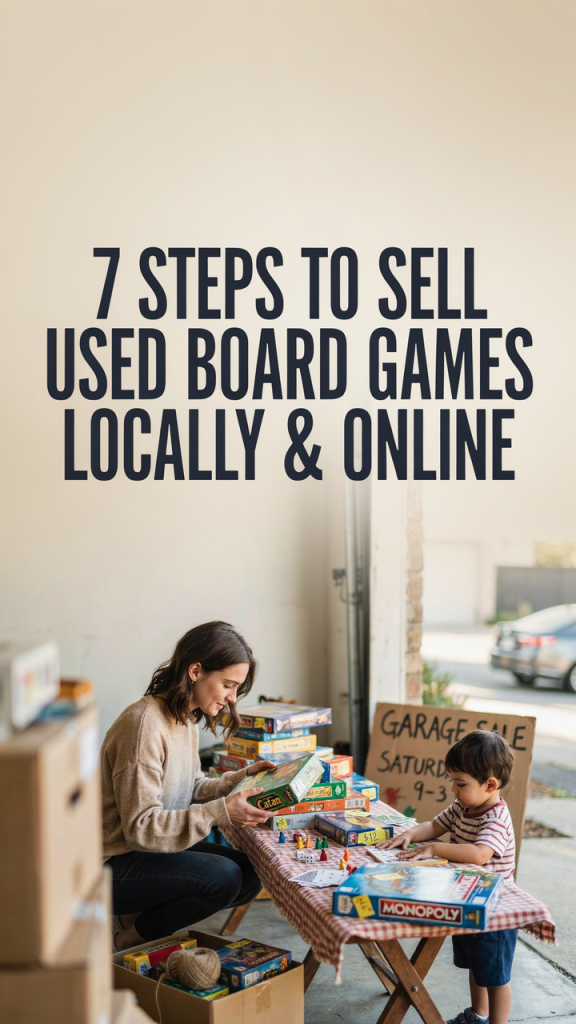
Flea markets, garage sales, pop-up swaps, conventions
Who: Bargain hunters, local gamers, and in-person collectors.
Speed vs price: Immediate cash and low fees, but prices per title are usually low.
Costs/fees: Stall fee or event entry; time investment to attend.
Best-case use: Bulk downsizing, older mass-market games, or moving lots of family titles.
Consignment and used-book/music stores that accept games
Who: General secondhand shoppers, occasional gamers.
Speed vs price: Moderate speed; stores often price for steady turnover—less than hobby channels but better than garage sale.
Costs/fees: Consignment split (20–50%) or low buyout.
Best-case use: Mixed lots, mass-market titles, and when you prefer not to handle individual sales.
Hybrid/peer-to-peer shipping apps and auction aggregators
Who: Sellers who want national reach without direct auction management.
Speed vs price: Moderate; some services help calculate shipping and upload to multiple marketplaces.
Costs/fees: Platform fees plus fulfillment/shipping.
Best-case use: Multi-item listings where you want to reach a wide buyer pool without manually posting everywhere.
Create Listings, Photos & Media
A clean, honest listing increases trust and reduces messages.
Title formula:
– For collectors: [Full Title] — [Edition/Year/Publisher] — [Condition] — [Notable extras]
– For common games: [Full Title] — [Condition] — [Player count / Play time / “Local pickup” or “Ships”]
First 1–2 lines:
– Put the most important selling point up front: edition, completeness, and condition. E.g., “Sealed expansion, 1st print, complete base game + promos — excellent condition.”
Essential details to include:
– Edition/printing and publisher
– Player count and play time (helpful for buyers scanning quickly)
– Complete component list and any missing items
– Any aftermarket modifications (sleeves, custom inserts, replacements)
– Shipping options (buyer pays, free shipping over X, or pickup only)
– Return policy or “sold as-is”
– Call-to-action (e.g., “Message for combined shipping on multiple games”)
Two short listing templates
– Collector game:
Title: Twilight Empires — 1st Edition (2014, XYZ Games) — Complete, VG+ w/Rulebook & Promo Pack
Body: 1st-edition Twilight Empires in very good-plus condition. All cards, tokens, minis, rulebook, and promo pack included; box shows light edge wear. No missing parts. Shipping preferred (buyer pays) with tracking & insurance; local pickup available. Ask for more photos. Accepting best offers above $125.
– Common family game:
Title: Ticket to Ride — Good condition — 2–5 players — Local pickup
Body: Ticket to Ride—complete, cards unpunched, rulebook present. Box corners scuffed from shelf storage. Great family game. $15 cash pickup in [zip], or I can ship for $7 via USPS if buyer pays shipping. Message to set up pickup.
Photo & media checklist (quick)
– Minimum set (5+ photos):
1. Box front (straight-on)
2. Box back (showing components list)
3. Insert/components tray in place
4. Components spread or cards fanned (if many cards, show sample faces)
5. Close-ups of any wear/damage (edges, creases, water marks)
– Lighting/background:
– Use natural light or a bright lamp; avoid shadows and flash glare.
– Plain neutral background (sheet, poster board).
– Short video ideas:
– 15–30 second pan of components and box.
– Quick demo of rulebook and setup to show completeness.
– Image specs:
– High-resolution JPEGs (at least 1000 px on the long edge). Crop unnecessary background but leave space to show scale.
Shipping, Packing, Negotiation & Safety
Prepare to protect the game, your money, and your time whether shipping or meeting locally.
Packing and shipping fundamentals:
– Materials: box or mailer that’s slightly larger than the game box, bubble wrap, foam sheets, packing paper, strong shipping tape, and corner protectors or foam.
– Protect the box: Wrap the box in bubble wrap at least 2–3 layers. Reinforce corners with foam or cardboard. For thin boxes, double-boxing is safest.
– Secure components: Place loose pieces in zip bags or small boxes; use paper or bubble fill so nothing shifts. Tape small pieces to a backing card if needed.
– Estimate shipping: Use platform shipping calculators for weight + dimensions. Offer “buyer pays shipping” unless the listing price includes it. For heavy games, consider flat-rate boxes if it’s cheaper.
– Insurance and tracking: For items over $50–100, include tracking; consider insurance above $100 depending on platform rules. Keep receipts and tracking numbers.
– Combining games: Stack smaller games inside a larger box with separators. Recalculate shipping based on actual weight and dimensions.
Negotiation etiquette and safe local sales:
– Price negotiation: Start with a firm but fair ask; allow small reductions or bundle discounts. Use “firm” only when you mean it; stating a lowest acceptable price internally helps you respond quickly.
– Meeting locations: Choose public, well-lit locations with camera surveillance—grocery store parking lots, police department exchange locations, or busy retail plazas. Avoid private homes.
– Payment methods: Cash is simplest for local pickups. For less cash on hand, use immediate-transfer apps (Zelle, Venmo) but prefer those with buyer/seller protections when possible. Avoid checks. If using apps, confirm receipt before handing over the game.
– Verifying condition: Allow the buyer to inspect components in the car trunk or inside the store. Keep photos of the item before the meetup to document pre-sale condition.
– No-shows & spam: For flaky buyers, confirm meetup time the morning of. If they don’t show, relist or move to the next prospect. Ignore or block repeat spam; respond with a short “Still available — first confirmed pickup/date holds” if needed.
Local meetup safety checklist:
– Share meetup details only after agreeing on price and payment method.
– Bring a friend if possible and meet during daylight.
– Don’t reveal personal addresses; use neutral locations.
– Confirm payment before handing over the item; for app payments, wait to see the cleared transfer notification.
After-sale, Records, Quick Reference & FAQ (and closing steps)
Handle disputes, keep basic records, and know where each title fits best.
Refunds, returns, and after-sale notes:
– Best practice: state your return policy upfront. “Sold as-is, no returns” is fine for local sales; online platforms may require different policies.
– Document condition: Keep the final listing photos and a short note (date, buyer handle, agreed price). These protect you if a buyer disputes completeness.
– Respond promptly: If a buyer reports a missing piece, respond courteously and offer solutions (partial refund, return, or help sourcing replacement parts). Negotiated resolutions preserve reputation.
Recordkeeping & tax basics:
– Log each sale: date, title, sale price, platform, fees, shipping cost, and net proceeds. Save screenshots or receipts.
– Taxes: Occasional sales of used personal items are rarely taxable as income, but frequent selling or profit-seeking can alter tax treatment. Consult a tax professional about thresholds and reporting. Keep records if you sell many games or run a small resale side business.
Quick reference: Best channel by goal
– Best for speed: Local marketplace apps / game shop trade-in
– Best for maximum price: Hobby forums (BGG), eBay auctions, specialty consignment
– Best for low effort: Peer-to-peer resale apps that handle payment/pickup
– Best for rare/collector items: Hobby forums, dedicated collectors, consignment with specialist shops
– Best for bulk downsizing: Garage sale, flea market, or bulk consignment
FAQ & troubleshooting (short)
– What if a game is missing pieces? Disclose it clearly; price as “complete except…” or sell for parts. Consider listing “complete minus X” and offer a small discount.
– How do I check a buyer’s credibility? On forums, check feedback/trust scores. On local apps, prefer verified profiles, prior positive ratings, and communicate clearly before meeting.
– Should I sell a damaged box? Yes—if the components are fine. Note box condition, price accordingly, and include photos of damage.
Final 3-step action plan
1. Inventory: Create a quick spreadsheet row for one game with condition and completeness.
2. Pick 1–2 channels based on your priority (speed, price, or effort).
3. Create one optimized listing using the templates, attach the photo set, and post.
Start with one title today—take clear photos, pick your channel, and post. Small, consistent sales add up, and with these tools you’ll keep more money in your pocket while avoiding common pitfalls. Good luck turning your games into cash.