Opening a door from a part-time side hustle to steady self-employment is exciting — and it’s also one of the most practical ways to gain time flexibility and control over your income. For stay-at-home moms and anyone balancing family responsibilities, the move needs to be deliberate: not a leap of blind faith, but a staged transition guided by clear benchmarks and financial checkpoints. Below is a realistic, step-by-step blueprint to help you decide when to go full-time, how to prepare, and what to do after you make the jump.
Why a staged transition matters
- Income from a fledgling business can be uneven. A staged transition reduces stress by keeping payroll and benefits intact while you build a stable base.
- A plan forces you to measure progress with objective criteria, not optimism alone.
- Practical checks (cash reserves, client diversity, systems) protect both your household and your business.
Decide if self-employment fits your life right now
Ask these decision-focused questions before you do anything else:
Build a practical AI-powered income plan in five days
Get a step-by-step framework for turning your skills and available time into a focused AI-powered side-income offer.
Lifestyle and time alignment
- Can your daily schedule realistically support consistent work blocks? If you need 10–20 hours/week now and hope to scale to 30–40, map when that extra time will come (childcare, partner support, swapping duties).
- Are you comfortable with irregular hours or periods of high intensity (product launches, client deadlines)?
- How important are employer benefits (healthcare, retirement matching, paid leave) compared with flexibility? If benefits are essential, factor their replacement cost into your plan.
Financial reality check
- What’s your monthly net household spend (bills, childcare, groceries, debt minimums)? This is the baseline your transition must cover.
- How dependent is the household on your current paycheck? If it covers a large share of fixed costs, plan for a longer runway and higher revenue targets.
- Are you prepared to handle taxes, invoicing, and irregular income? If not, commit to learning or budgeting for an accountant.
Readiness benchmarks: measurable signals you’re ready to go full-time
Use these objective benchmarks as a minimum framework. Think of them as “green lights” rather than guarantees.
Revenue stability
- Consistent gross revenue at or above your monthly personal living expenses for 3 consecutive months, with positive year-over-year trend or upward momentum.
- A practical safety margin: aim for 1.25–1.5× your current net take-home pay before quitting a job. The multiplier accounts for taxes, benefits replacement, and startup reinvestment.
Profitability and margins
- Business is profitable on a simple owner’s-draw basis: after paying contractors and fixed business costs, there’s enough left to cover your personal draw and taxes.
- Target gross margins that make sense for your industry (e.g., 50%+ for information products, lower for physical goods after COGS). If margins are thin, you’ll need higher revenue or cost restructuring.
Cash reserves and runway
- Personal emergency fund: 6–12 months of household living expenses (short end if you have a partner with stable income; longer if sole household earner).
- Business runway: 3–6 months of fixed business expenses saved to cover software, contractor payments, and marketing if income dips.
Client concentration
- No single client should represent more than 20–30% of total revenue, or you risk major disruption if they leave.
- Ideally maintain multiple income streams (services, products, recurring subscriptions) so a single slowdown doesn’t derail cash flow.
Operational readiness
- Core processes documented: client onboarding, billing, fulfillment, quality checks.
- One or two key tasks are delegated or automatable (email templates, invoicing, social scheduling).
- Basic bookkeeping system and separate business bank account are in place.
Financial checkpoints — what to save and track before you quit
These are the numbers and accounts you should lock in before handing in your notice.
Personal emergency fund
- Aim for 6–12 months of essential living costs in an accessible savings account. This fund is for household emergencies, not business reinvestment.
Business reinvestment fund
- Set aside 3–6 months of expected business operating costs to fund growth (ads, product development, contractors). Treat this like payroll for your business.
Tax reserve account
- Dedicate 20–30% of business income (adjust for your tax bracket and local tax rules) to a separate savings account to cover quarterly estimated taxes if required.
Benefits and retirement
- Determine the monthly replacement cost for health insurance, disability insurance, and retirement contributions. Include this amount in your personal monthly budget and target revenue.
Minimum monthly revenue target — a simple formula
1. Total monthly personal expenses (A)
2. Replacement cost of benefits & taxes (B)
3. Small reinvestment buffer (C) — e.g., $300–$1,000
Monthly target = A + B + C
Use conservative estimates; better to exceed your target occasionally than regularly fall short.
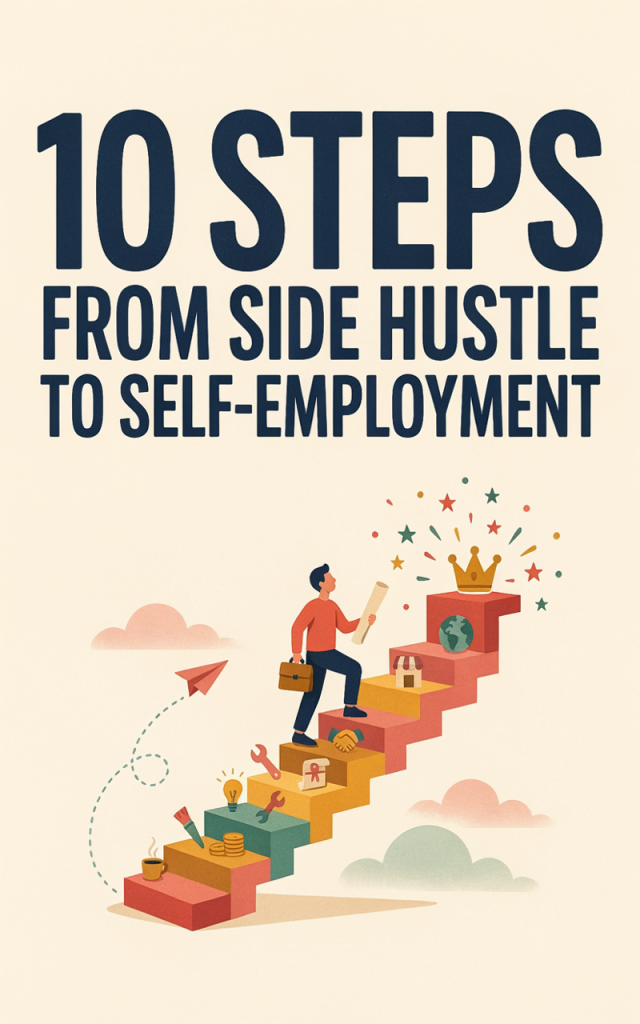
A practical transition timeline: 3, 6, and 12 months
Map out milestones and tasks across short, medium, and longer terms.
3-month goals (validate and stabilize)
- Track revenue and client acquisition metrics weekly.
- Secure 3 months of consistent revenue meeting your lower threshold (e.g., covering a core portion of living expenses).
- Separate finances: open business account, set up invoicing, and implement basic bookkeeping.
- Create templates for proposals, contracts, and onboarding.
6-month goals (build systems and diversify)
- Hit the revenue target defined above for 3 consecutive months.
- Reduce client concentration risk by adding new clients or products so no single source >25% revenue.
- Automate routine tasks (scheduling, billing reminders, email sequences) and test outsourcing one recurring task.
- Begin setting aside tax and reinvestment reserves.
12-month goals (transition-ready)
- Personal emergency fund of 6–12 months in place.
- Business runway fund of 3–6 months saved.
- Consistent monthly revenue at or above 1.25× current net take-home pay for at least 3–6 months.
- Documented processes, at least one reliable contractor or VA, and a predictable lead generation system.
- Plan for benefits replacement (insurance quotes, retirement accounts) and tax planning with a professional.
Practical actions to scale your side hustle
These activities move you from hobby to business-ready.
Validate and price smarter
- Run small paid tests: Facebook/Instagram ads, pre-orders, or limited coaching packages to measure conversion rates.
- Calculate your true hourly rate including non-billable time; price to cover that rate plus business overhead.
Systemize and outsource
- Document repeatable tasks with short SOPs (standard operating procedures).
- Outsource time-consuming but low-value work first: scheduling, bookkeeping, social graphics.
- Use automation tools for email funnels, invoicing, and appointment scheduling.
Focus on marketing and retention
- Build a predictable funnel: regular content (blog, email, short-form video) that drives opt-ins and then nurtures leads.
- Improve customer lifetime value: add follow-up offers, memberships, or maintenance packages to turn one-time buyers into recurring revenue.
- Track key metrics: lead volume, conversion rate, average order value, churn for subscriptions.
Realistic limits and risk management
Be honest about constraints and protect your family and sanity.
Income volatility
- Plan for quiet months; don’t assume linear growth. That’s why cash reserves and multiple income streams matter.
Time and capacity
- As a parent you may face competing demands. Set conservative productivity targets and allow buffer time for caregiving duties, illness, and school schedules.
When to pivot vs. persevere
- Pivot if customer feedback consistently shows weak demand after two major tweaks, or the economics never reach sustainable margins.
- Persevere when metrics improve (higher conversion, repeat purchases, rising average order value) and you’re closing revenue gaps toward your target.
Legal and tax basics
- Formally separate business and personal finances. Consider an LLC or similar structure after assessing liability risk and tax implications.
- Use a basic invoicing and bookkeeping solution. Consult a tax professional to set up quarterly estimated taxes and advise on deductions.
Protect your mental health and family finances
- Put clear boundaries on work hours and childcare responsibilities.
- Communicate the plan and timeline with partners or family who help financially or logistically.
- Schedule regular breaks to avoid burnout; sustainable self-employment is a marathon, not a sprint.
A final, practical checklist before you quit
- [ ] Personal emergency fund: 6–12 months saved
- [ ] Business runway: 3–6 months saved
- [ ] Consistent revenue at or above target for 3–6 months
- [ ] No client >25–30% revenue
- [ ] Profitability after business expenses and owner’s draw
- [ ] Documented processes and at least one outsourced task
- [ ] Tax reserve account and plan for benefits replacement
- [ ] Clear timeline for transition and role adjustments at home
Making the leap is a personal and financial decision. Use these benchmarks to know whether you’re building a stable bridge or should wait another season to strengthen the foundation. Remember: many successful full-time entrepreneurs didn’t quit overnight — they extended the runway, tightened processes, and made incremental leaps. With clear metrics, realistic savings goals, and operational routines, you can reduce risk while moving closer to a flexible life that balances income and family priorities.
When you’re ready to start a 90-day sprint to shore up revenue, processes, and savings, use the transition timeline above as your working playbook. Small, measurable wins compound into sustainable self-employment — and that’s the goal worth planning for.
Decide your first hire and minimal tech stack
Make hiring a numbers decision: hire only when the cost of outsourcing is less than the value of time you regain. Quick rule: estimate your billable (or target) hourly value; if a VA at $20/hr frees 5+ hours/week you’d otherwise spend on revenue work, it’s worth hiring.
Setup specifics: baseline tools — Google Workspace $6–12/mo, QuickBooks $20–40/mo, Calendly $8–15/mo, project board (Trello/Asana) free–$10/mo. Typical rates: VA $15–30/hr, designer/developer $40–100+/hr, bookkeeping $200–400/mo.
Onboarding/time: 1–3 days to set accounts, 1–3 weeks of supervised work using SOPs. Limit contractor spend to ~20–25% of monthly revenue until ROI is proven; use a 30–60 day paid trial to validate impact.