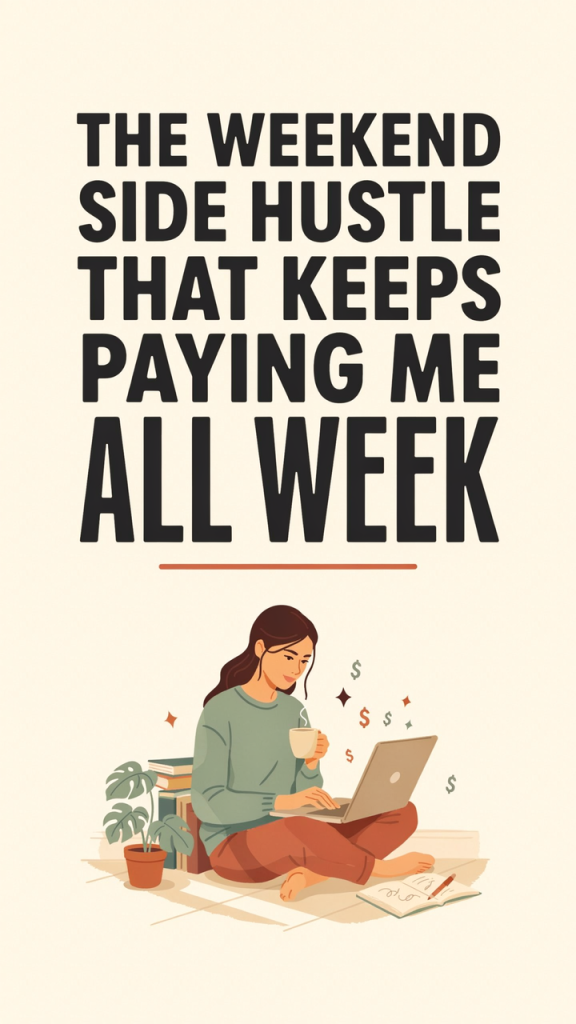
Have you ever spent a Saturday tinkering on a little project—designing a printable planner, putting together a mini course, or creating a simple template—and then checked your phone on Monday to see sales rolling in while you made breakfast and packed lunches? That’s exactly how I fell in love with a particular weekend side hustle: I build small digital products and put them behind a simple sales funnel on Sunday, and the sales keep coming all week. If you’re a stay-at-home mom or anyone craving flexible extra income, this method lets one focused weekend produce income and momentum that pays off days later.
What the side hustle is
The short version: create evergreen digital products during a weekend and sell them through an automated sales funnel. The products I recommend for a low-friction weekend build are things like printable planners, Canva templates, social media content packs, budgeting spreadsheets, mini email courses, or simple PDFs/workbooks. These are low-cost to produce, infinitely deliverable, and highly search-friendly.
You sell them on marketplaces like Etsy or Gumroad, or on your own storefront (Shopify, SendOwl), and use a lightweight funnel—lead magnet, email welcome sequence, and an optimized sales page—to turn traffic into repeat buyers. Once the funnel is set up, it requires very little day-to-day attention: the product lives digitally, the checkout is automated, and your email sequence nurtures and converts customers while you handle family and life.
Build “A $373/Day AI Powered Side Hustle In Just 5 Days”
Follow the step-by-step training to turn practical AI skills into a focused income stream.
Why it works
There are three big reasons this strategy fits stay-at-home moms and anyone wanting flexible income:
- Low upfront time and cost: You can design a quality printable or template in a few hours using Canva, Google Sheets, or simple design tools. No inventory, shipping, or complex tech.
- Evergreen appeal and scalable distribution: Products like planners and templates solve recurring problems. You create once and sell many times. Marketplaces and organic channels (Pinterest, SEO) keep bringing buyers.
- Automation + leverage: A simple email sequence and a solid sales page act as your “salesperson” 24/7. You do the creative work during your free time (weekends) and let automation do the selling during the week.
Plus, these products fit into busy schedules. You can batch-create a few items on Saturday while the kids nap and finalize listings on Sunday evening.
How to get started step-by-step
Here’s a practical weekend-by-weekend roadmap to launch your first product and funnel.
Weekend 1 — Research & validation
1. Pick a niche you know or enjoy (family planners, homeschool templates, meal planning, budgeting).
2. Validate demand: search Etsy/Pinterest keywords, check best-sellers, or run a quick poll in a Facebook group.
3. Decide product type and price (printables $3–$15, templates $5–$25, mini-courses $20–$100).
Weekend 2 — Create the product
1. Use Canva, Google Sheets, or PowerPoint to design. Keep it simple—clarity > complexity.
2. Create 2–3 variations or cover colors for testing.
3. Write a short description, benefits list, and a FAQ.
Weekend 2 (Sunday evening) — Set up sales infrastructure
1. Choose a platform: Etsy (good for discoverability) or Gumroad/Shopify (control + margins).
2. Build a one-page sales page or optimized product listing. Use strong keywords and benefit-focused copy.
3. Create a free lead magnet (a small sample worksheet or checklist) for your funnel.
Weekend 3 — Funnel & automation
1. Set up an email service (MailerLite, ConvertKit, or Mailchimp) and create a 3–5 email welcome/sales sequence.
2. Create a landing page for the lead magnet using your email tool or a simple page builder.
3. Link your product purchase to an automated delivery and follow-up upsell or cross-sell email.
Traffic plan (ongoing)
– Pin one product image to Pinterest daily using Tailwind or manual pinning.
– Share in relevant Facebook groups, Instagram stories, or Mom-focused forums (respect group rules).
– Optimize product listing with SEO keywords in title and tags.
Tools I use and recommend
– Canva for design
– Etsy + Gumroad for selling
– ConvertKit/MailerLite for email automation
– Tailwind for Pinterest scheduling
– Google Analytics and platform dashboards to track sales
Realistic income expectations
Be honest with yourself: this isn’t a get-rich-quick scheme, but it is real passive income that compounds.
- Month 0–1 (launch): $0–$200. Most creators get a few sales as they fine-tune listings and SEO.
- Month 2–4: $200–$1,000/month. With a steady Pinterest strategy or a small ad push, consistent sales begin.
- Month 6+: $1,000–$5,000+/month. Once you have multiple products, an email list, and optimized funnels, revenue can scale significantly.
Example math:
– If your product priced at $8 sells 50 times a month → $400/month.
– A bundle of three products at $15 selling 40 times → $600/month.
Factors that influence income: product relevance, quality of listing/sales page, traffic sources, and email conversion rates. Treat the first months as testing and learning—most creators see growth once they optimize listings and build an email list.
Tips to scale
Once you’ve got a product that sells, invest time in these scalable moves:
- Create bundles and upsells: Offer a multi-pack discount or a companion product during checkout to increase average order value.
- Build a subscription or membership: Monthly planner packs or content calendars create recurring revenue.
- Grow your email list: Email converts better than cold traffic—use your freebie to keep nurturing.
- Leverage Pinterest and SEO: Optimize titles and descriptions; repin and refresh pins to keep traffic flowing.
- Repurpose content: Turn a printable into a workbook, then into a short course or video tutorial.
- Outsource parts of the process: Hire a VA to manage listings, a designer for new templates, or a Pinterest manager to scale traffic.
- Run small paid experiments: $5–$20/day Pinterest or Facebook ads to profitable pins or listings can dramatically increase visibility when targeting the right audience.
Common mistakes to avoid
Avoid these pitfalls I learned the hard way:
- Skipping validation: If there’s no demand, you won’t sell. Validate before spending hours designing.
- Overcomplicating the product: A clean, usable product beats a cluttered one every time.
- Ignoring keywords and SEO: Listing titles and descriptions drive discovery—use relevant long-tail keywords.
- Not building an email list: Relying on a single platform is risky; an email list gives you control.
- Pricing too low: Undervaluing your work hurts conversion and ability to scale. Test pricing with bundles.
- Giving up too early: Most income takes consistent tweaks and time. A product often needs 3–6 months to show traction.
- Copying blindly: Model successful listings, but add your unique value and genuinely helpful features.
If you want a flexible side hustle that respects family time and delivers returns throughout the week, creating digital products and routing them through a simple automated sales funnel is one of the best bets. I started by spending a single weekend building a planner and a landing page—and within weeks it paid for groceries and then more. The beauty is in the leverage: a few concentrated hours make something that sells while you live your life.
Ready to try it? Pick one small product idea and commit one weekend to build and list it. Don’t wait for the “perfect” moment—start small, validate quickly, and iterate. Your weekend work can become a dependable income stream during the week. Let me know what product you’re thinking of creating—I’ll reply with a quick validation tip to get you started today.