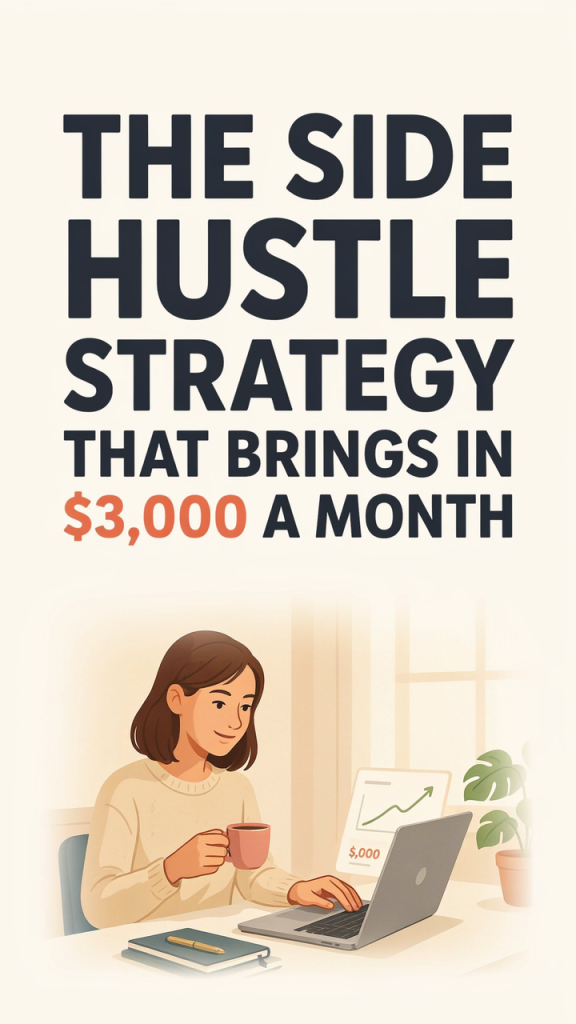
Have you ever sat down with a cup of coffee after bedtime, scrolled through your phone, and thought, “There has to be a way to bring in real money without missing school pick-up or soccer practice”? That was me two years ago — juggling diaper changes, playdates, and the nagging pile of bills. I wanted flexible income that respected my schedule but actually paid the bills. What started as a late-night side project turned into a consistent strategy that brings in about $3,000 a month. I’m sharing exactly how I built it so you can start this week — even if you’ve never made a sale online before.
What the side hustle is
The side hustle I’m talking about is a niche blog combined with simple sales funnels: content that attracts an audience + a free lead magnet that builds an email list + automated email funnels that sell low- to mid-ticket digital products and affiliate offers.
In plain terms:
– You create helpful blog posts (and pins or social posts) that solve a specific problem for a well-defined audience (for example: busy moms who meal-plan).
– You offer a small, useful freebie (a lead magnet) to capture email addresses.
– You send a short email funnel that nurtures trust and presents a paid product or affiliate recommendation.
– You repeat and optimize — more helpful content and more funnels — and your income grows predictably.
This isn’t about ads alone or chasing virality. It’s about building a reliable audience and giving them products they’ll gladly buy because you solved a real problem.
Build “A $373/Day AI Powered Side Hustle In Just 5 Days”
Follow the step-by-step training to turn practical AI skills into a focused income stream.
Why it works
There are a few reasons this strategy hits $3,000/month reliably:
- Leverage and compounding — evergreen blog posts keep bringing in traffic long after you publish. One well-optimized post can drive traffic for years.
- Ownership — you own the email list. Social platforms can change their rules; your list stays yours.
- Scalability — once a funnel is built and converts, each new subscriber has a predictable lifetime value.
- Low overhead — hosting and email tools are inexpensive. Your main investment is time (or a small budget for help).
- Flexibility — you can create content in batches during naps, school hours, or evenings. That matters when you’re a stay-at-home parent.
I went from 0 to consistent income by focusing on helpful content and simple funnels rather than trying to be everywhere at once.
How to get started step-by-step
Here’s a practical roadmap you can follow this month:
- Pick a niche (1–3 days)
- Choose a narrow audience + problem (e.g., “meal planning for picky toddlers” vs. “parenting”). Narrow niches convert better.
- Validate by searching Facebook groups, Pinterest, or Amazon to see what questions/topics come up frequently.
- Set up your platform (1–2 days)
- Buy a domain and basic hosting (SiteGround, Bluehost, or similar).
- Install WordPress and a simple theme (Astra, GeneratePress).
- Set up Google Analytics and Search Console.
- Do basic keyword research (3–5 days)
- Use free tools (Google Autocomplete, AnswerThePublic) and a small paid tool (Keywords Everywhere or Ubersuggest) to find low-competition, high-intent keywords.
- Target long-tail phrases (e.g., “30-minute toddler meal plan”) for quick wins.
- Create 3 cornerstone blog posts (2–3 weeks)
- Write 3 detailed, helpful articles that answer common problems in your niche.
- Include actionable steps, checklists, and images/screenshots.
- Optimize for SEO: clear title, meta description, headings, and internal links.
- Build a lead magnet (1 week)
- Make a simple PDF checklist, mini-email course, printable, or template that solves an immediate pain point.
- Use Canva to design it and your email provider (ConvertKit, MailerLite) to create a signup form.
- Create a 5-email funnel (1 week)
- Email 1: Deliver the lead magnet + welcome.
- Email 2: Share a helpful story/tip.
- Email 3: Show a success/example.
- Email 4: Present a low-cost product or affiliate recommendation (tripwire).
- Email 5: Urgency/FAQ + final call to action.
- Launch a small product or affiliate offer (1–3 weeks)
- Tripwire: $7–$27 checklist, template, or mini-course.
- Core product: $27–$97 course or bundle.
- Affiliate offers: Choose reputable programs that fit your audience.
- Drive traffic (ongoing)
- Pin your posts on Pinterest (very effective for mom niches).
- Share in niche Facebook groups (where allowed).
- Do basic on-page SEO and promote to friends/newsletters.
- Track and optimize (monthly)
- Check open rates, click-through rates, and conversion rates.
- Tweak subject lines, call-to-actions, and landing pages.
If you follow these steps and stick with the process, you’ll begin to see conversions within 1–3 months. Consistency compounds.
Realistic income expectations
Let’s be honest: it’s not magical. Hitting $3,000/month usually requires a mix of products/offers and an engaged list. Here are three realistic scenarios:
- Early stage (month 1–3)
- Email list: 200–500
- Monthly revenue: $0–$300
- Focus: traffic, list-building, validating offers.
- Growth stage (month 4–9)
- Email list: 1,000–3,000
- Monthly revenue: $300–$1,200
- Mix: tripwire sales + some affiliate income.
- Scale stage (month 9+)
- Email list: 3,000–10,000
- Monthly revenue: $1,200–$5,000+
- Mix: multiple funnels, a core product, affiliates, and possibly memberships.
Example math to reach $3,000:
– 5,000 subscribers with a 2% conversion each month buying a $30 product = 5,000 * 0.02 * $30 = $3,000.
– Or: 3,000 subscribers with a $10 product (5% buy rate over multiple offers) + $500 affiliate + $200 recurring membership.
Important: conversion rates vary. An engaged niche list will outperform a large but cold list. That’s why the lead magnet and quality content matter.
Tips to scale
Once you’re making consistent sales, here’s how to grow without burning out:
- Create a higher-ticket offer (mini-course or coaching) for customers who need more help.
- Add recurring revenue (monthly membership or subscription).
- Reuse content: turn a blog post into a short video, social post, and email.
- Invest in Pinterest ads or Facebook ads to amplify your best content.
- Automate routine tasks and hire a virtual assistant for content repurposing or customer support.
- Host webinars/FB Lives for bigger launches.
- Optimize funnels: A/B test subject lines, email copy, and landing pages.
- Collaborate with other creators for guest posts and joint offers.
Scale smartly: pay for help where you’re inefficient (e.g., graphics, tech setup), and keep the strategic work — product creation and audience relationship — in-house until you can afford otherwise.
Common mistakes to avoid
I made some of these early on. Avoiding them will save you time and stress:
- Too broad a niche — if you try to help everyone, you’ll attract no one. Narrow down.
- Chasing shiny tactics — hopping from one platform to another wastes momentum.
- Ignoring the email list — social-only strategies are fragile.
- Overproducing freebies — one great lead magnet is better than ten mediocre ones.
- Skipping validation — don’t build a big course before you know people will pay for it.
- Not tracking metrics — if you don’t know open or conversion rates, you can’t improve.
- Expecting overnight results — consistent small wins add up, but it takes time.
When you mess up (and you will), treat it as data: adjust and move forward.
If you’re a stay-at-home mom (or anyone craving flexible, real income), this niche blog + funnel approach is one of the most sustainable paths I’ve found. It respects your schedule, scales with smart effort, and leads to predictable income — the kind that lets you breathe and make choices for your family.
Ready to start today? Do this now: pick a niche, write your first blog post outline, and draft a simple lead magnet idea. Commit 2–3 focused hours this week and take the first tangible step — momentum builds fast once you begin.
If you want, tell me your niche idea in the comments or save this post as your checklist. I’ll be here to help you troubleshoot the funnel and celebrate your first sale. Let’s get you to that $3,000 month — one helpful post and one funnel at a time.