I stopped being “all things to all readers” — I picked a profitable niche and audience
Description
One of the earliest, and most important, changes was narrowing my focus. For years I wrote about anything that interested me. The result: mediocre traffic, low engagement, and zero repeat visitors. I chose a tight niche—helping solopreneurs build email-first funnels—and that clarity made everything easier: keyword selection, product ideas, messaging, and conversions.
Actionable tips
– Define your target reader in one sentence: “I help [who] solve [specific problem] in [timeframe].”
– Validate demand with keyword tools (Google Search Console, Ahrefs, Keywords Everywhere) and check existing monetization (affiliate products, courses).
– Pick 2–3 content pillars (e.g., list building, funnel setup, monetization) and commit to them for 6–12 months.
Real-world context
When I narrowed to “email-first funnels for creative solopreneurs,” my search intent matched my product suite. Affiliate offers and course ideas started making sense, and outreach to potential partners became straightforward because both parties knew the audience.
Ready for a guided, five-day action plan?
A content strategy that ranks: pillars, clusters, and regular updates
Description
Instead of random posts, I built a content architecture: a few long-form pillar pages (cornerstone content) supported by cluster posts that target long-tail keywords and link back to those pillars. This structure signals topical authority to Google and keeps readers on my site longer.
Actionable tips
– Create 3–5 pillar posts (2,000–4,000 words) that cover core problems end-to-end.
– Write 8–12 cluster posts (1,200–1,800 words) answering narrower questions; link them to the pillar with contextual anchor text.
– Optimize on-page SEO: title tags, meta descriptions, header structure, and images. Use Search Console to find low-hanging keywords to improve.
– Schedule content updates every 6–12 months—refresh stats, add new examples, improve internal links.
Real-world context
I started with a pillar post on “Building an Email-First Funnel.” It ranks for multiple mid-volume keywords and acts as a gateway to affiliate posts and my paid product pages. Updating it quarterly led to sustained gains rather than spikes.
Traffic systems: SEO as the backbone, supplemented by Pinterest and email
Description
Organic search is my highest-quality source of traffic. But relying on one source is risky. I treat SEO as the backbone and layer Pinterest for quick discovery and email for repeat visits and conversions.
Actionable tips
– Use Google Search Console weekly to find rising queries and pages with CTR improvements.
– Build topical relevance with internal links and by answering “people also ask” questions.
– Optimize 3–5 Pinterest images per post and schedule them (Tailwind or native scheduler).
– Repurpose posts into short newsletters that reconnect cold subscribers to evergreen content.
Real-world context
SEO provided steady impressions; Pinterest drove fast, visual traffic spikes for product launches; email turned those visits into purchases. For a launch, Pinterest sent a 30% traffic increase and my email list converted at 2.8%.
A monetization funnel that converts: lead magnets, tripwires, and flagship offers
Description
Traffic without a funnel wastes potential. I built a simple funnel: lead magnet → tripwire (low-cost offer) → core product → backend upsell. The email list became the engine that turned visitors into buyers.
Actionable tips
– Create a high-value lead magnet tied to a specific pain point (checklists, swipe files, mini-workshops). Aim for a 20–40% opt-in rate for targeted landing pages.
– Offer a tripwire at $7–$47 (template packs, mini-course). Track conversion rates—most sites convert 2–5% on tripwires; optimize with urgency and bonuses.
– Price your core course based on value (not production cost). I used $97–$297 bands for mid-ticket and offered payment plans.
– Automate a 7–10 email sequence: welcome → deliver value → product intro → FAQ/objections → scarcity reminder.
Real-world context
My lead magnet converted 27% on an optimized landing page. The tripwire (a funnel swipe file) converted 4.2%. These micro-conversions lowered the break-even on paid ads and increased the lifetime value of subscribers.
Conversion rate optimization: make buying easy and obvious
Description
Small changes on pages and in email can move the revenue needle. Focus on clarity, speed, and trust. If the buying path is confusing, people drop off—even if they like your content.
Actionable tips
– Use clear, benefit-driven CTAs above the fold and at the end of posts.
– Add social proof (testimonials, case studies, real numbers) on product pages.
– Shorten checkout process: remove unnecessary fields, offer autofill, display security badges.
– A/B test pricing pages, headlines, and call-to-action text. Even a 0.5% lift in conversion can add hundreds per month.
Real-world context
After simplifying my checkout from three pages to one and adding a short testimonial video, my paid conversion rate increased from 1.6% to 2.4%, adding several hundred dollars each month without adding traffic.
Systems and outsourcing: scale without burning out
Description
You can’t do everything. I learned to systemize the repetitive tasks and outsource strategically—content editing, Pinterest graphics, and customer support—while keeping strategy and product creation in-house.
Actionable tips
– Create SOPs for recurring tasks (content publishing, quality checks, email sequences).
– Hire freelancers for specific tasks: a writer for cluster posts, a designer for lead magnets, a VA for email ops.
– Use tools for project management (Notion, Asana) and a shared content calendar.
– Batch work: record videos or draft multiple posts in a single session to reduce context switching.
Real-world context
Outsourcing the Pinterest design and scheduling saved me 8–10 hours a week. That time went into product development, which produced my highest revenue months.
Habits and metrics I watch every week
Description
Daily hustle without measurement is wasted effort. I track a handful of KPIs that directly relate to revenue and make weekly adjustments.
Actionable tips
– Weekly dashboard: sessions, new subscribers, conversion rate (lead magnet and product), and revenue.
– Monthly deep-dive: channel performance, top posts, churn for paid products.
– Focus on revenue per subscriber (RPS) rather than vanity metrics like raw pageviews.
– Set quarterly goals and reverse-engineer the content and launch schedule to hit them.
Real-world context
When I shifted attention from pageviews to RPS, I stopped chasing virality and started improving funnels. That single mindset change increased average monthly income by ~15% over six months.
Conclusion — make your blog a business, not a hobby
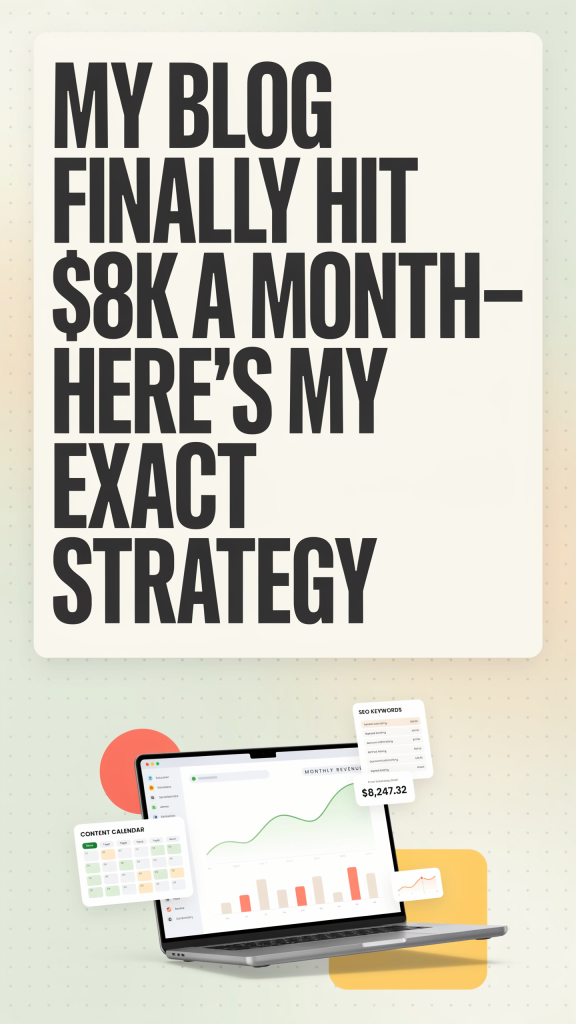
Turning a blog into a predictable $8,126/month business wasn’t a single hack—it was a series of focused changes: niche clarity, an intentional content architecture, diversified traffic sources, a conversion-first funnel, and systems that allowed me to scale. You don’t need to copy me exactly—adapt the framework to your strengths and audience.
Ready to start? Take these three micro-steps today:
1. Define your niche in one sentence.
2. Draft a lead magnet idea tied to a top-performing post.
3. Plan one pillar post and three cluster posts for the next 90 days.
If you take those steps and keep the systems above in place, you’ll be surprised how quickly momentum builds. Want more guides and templates for building funnels on your blog? Subscribe to Blogging With Funnels and I’ll send practical, step-by-step playbooks straight to your inbox.