Choose a focused niche and adopt a value-first mindset
Description
A laser-focused niche made everything easier: keyword choices, content ideas, email opt-ins, and product creation. I moved from “business & marketing” (way too broad) to “blogging income strategies for beginners.” That focus made it obvious what my target reader needed and where I could help.
Actionable tips
– Pick a niche you can write about consistently for 12–24 months. Interest + profit potential = sweet spot.
– Define your avatar: age, goals, problems, and where they hang out online.
– Write a one-sentence promise: “I help X do Y by Z.” Use that on your about page and in your content.
Real-world context
When I narrowed my niche, my bounce rate dropped and average session duration increased—because visitors found more content that fit their exact problem. Niche clarity also made monetization natural: affiliate tools and a first digital product matched the audience’s needs.
Ready for a guided, five-day action plan?
Build a simple pillar content strategy
Description
Pillar content = the evergreen posts that attract repeat traffic and serve as anchors for your site. I built 5–7 core posts (guides, tutorials, comparison posts) and then wrote shorter, supporting posts that linked to them.
Actionable tips
– Create 5 pillar topics: your best, most comprehensive posts (2–3k words each).
– Map supporting posts (FAQs, case studies, listicles) to each pillar and interlink them.
– Use clear content templates: intro, problem, solution, step-by-step, CTA.
Real-world context
My top 5 pillars drove 70% of my organic traffic. One pillar post about “how to start a blog for profit” ranked on page one and consistently generated affiliate clicks, email signups, and new customers.
Do basic SEO and targeted keyword research
Description
You don’t need to be an SEO wizard to get traffic—just consistent keyword research and on-page SEO. I targeted long-tail, buyer-intent keywords that aligned with my funnel.
Actionable tips
– Use free/cheap tools (AnswerThePublic, Google Keyword Planner, Ubersuggest) to find long-tail queries.
– Optimize title, URL, H2s, and meta description for your primary keyword.
– Add a “Related posts” section linking to other content to boost internal linking.
– Implement schema for articles and FAQs where it makes sense.
Real-world context
Targeting long-tail keywords (e.g., “how to set up a blog email funnel for beginners”) let me rank faster. I didn’t try to outrank huge authority sites; instead, I created better, more actionable posts for beginners and earned featured snippets and steady traffic.
Capture emails with a lead magnet and a simple funnel
Description
Traffic is temporary without an email list. My list is what turned casual readers into buyers. I created a small but valuable lead magnet and a 3-email onboarding sequence that led to a low-cost offer.
Actionable tips
– Create a lead magnet tied directly to a pillar page (checklist, mini-course, swipe file).
– Place opt-ins strategically: top-bar, end-of-post, and a 2-step lightbox on pillar posts.
– Use a 3–5 email welcome sequence: deliver value, show social proof, make a soft offer.
– Track conversion rates: page -> opt-in -> email open -> click -> purchase.
Real-world context
My lead magnet converted at ~6% on pillar pages. The welcome sequence warmed readers so that when I launched a $47 mini-course as a tripwire, it converted at ~3–4% on the list—enough to fund further content and ads.
Monetize with an ethical mix: affiliate marketing + digital products + services
Description
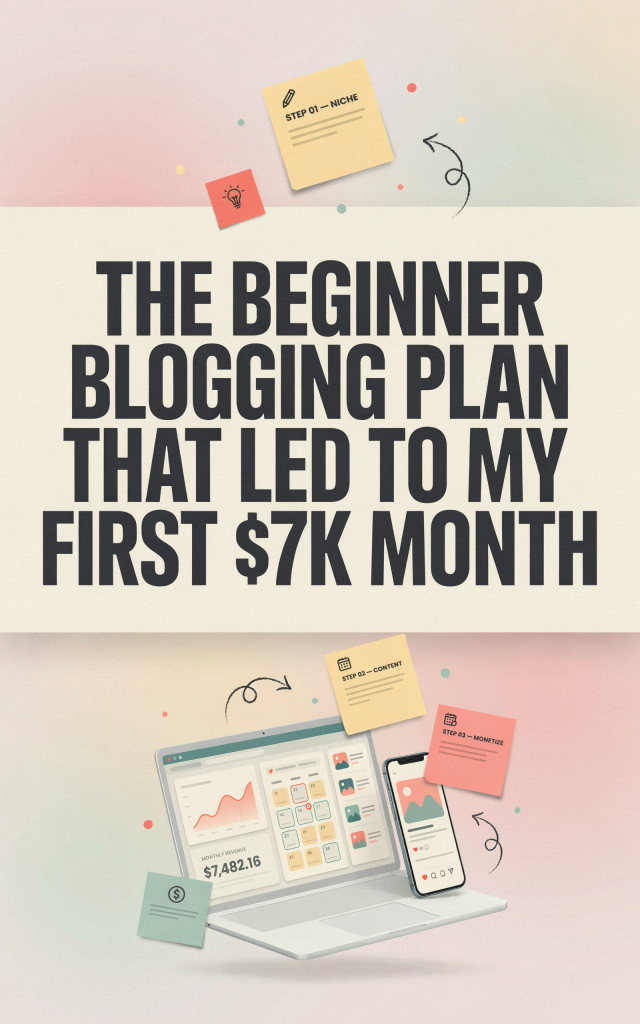
A blended monetization strategy reduced risk. In my $7K month the revenue came from a combination of a small digital course, affiliate commissions from recommended tools, and a few client coaching sessions.
Actionable tips
– Start with affiliate products that genuinely solve your reader’s problem; always disclose affiliate relationships.
– Create a low-ticket product (mini-course, templates) to convert your email list; price it to be an easy yes ($27–$97).
– Offer higher-value services (coaching, done-for-you) as an upsell for your most engaged readers.
– Use scarcity (limited spots) or bonuses to drive action during launches.
Real-world context
Example income mix from a sample month: $3,500 course sales, $2,000 affiliate commissions, $1,500 coaching — that added up to my first $7K. The course started as a collection of posts turned into lessons; affiliates were tools I’d used for months and recommended honestly.
Develop consistent publishing habits and track the right metrics
Description
Consistency is what compounds. I set a realistic publishing cadence and tracked a handful of metrics that mattered, not every vanity metric.
Actionable tips
– Start with a publish schedule you can sustain (one pillar post every 2–3 weeks + shorter posts weekly).
– Batch work: research one day, write another, edit another. Use content templates and outlines.
– Track these KPIs: organic sessions, email opt-in rate, list growth, conversion rate, revenue per channel.
– Do a monthly content and income review; double down on what works, prune what doesn’t.
Real-world context
When I moved to bi-weekly pillar posts and weekly short posts, traffic grew steadily. Reviewing metrics monthly allowed me to notice which posts generated affiliate sales and which drove signups—so I optimized promotion and internal linking accordingly.
Scale smart: outsourcing, automation, and iterating
Description
Once revenue stabilized, I reinvested in the blog: a virtual assistant, a contract writer, and a part-time ad budget to accelerate winners. Scaling didn’t mean throwing more content at it; it meant systematizing what worked.
Actionable tips
– Document processes (outlines, publishing SOPs) before hiring.
– Outsource writing for supporting posts; keep pillar posts personal/high-touch.
– Automate email segmentation and tagging to personalize offers.
– Test paid traffic for top-performing posts with small budgets first.
Real-world context
Hiring a writer to produce supporting posts freed me to focus on product creation and partnerships. Automation in my email platform increased repeat purchases by enabling targeted follow-ups to buyers vs. non-buyers.
Mistakes I made and what to avoid
Description
I learned faster by failing cheaply. Many early mistakes were avoidable if I’d stuck to fundamentals.
Actionable tips
– Don’t chase every “shiny” platform; focus on content and list-building first.
– Avoid creating products before you validate demand—pre-sell or survey your list.
– Don’t ignore analytics—minor tweaks to CTAs and subject lines raised conversion rates.
– Don’t undersell your time or devalue your products to chase volume.
Real-world context
I once spent money building a polished course that flopped because I hadn’t validated it with my list. After that, I pre-sold the next offer, which validated the idea and covered development costs before I created the full product.