The dream of building a successful Pinterest presence, driving traffic, and growing a loyal following is a powerful one. But the reality is, the vast majority of Pinterest accounts that are started with these ambitions never achieve them. While it’s difficult to find official statistics, the principle remains the same as with other content platforms: a small percentage of creators see the lion’s share of success, while most struggle to gain traction.
But first, why should you listen to me I’m Nick Garcia, Pinterest marketing expert, I make 200K a year from Pinterest and by the end of this year, I’ll be making $1,000 a day, how do I know? Because I just do OK!
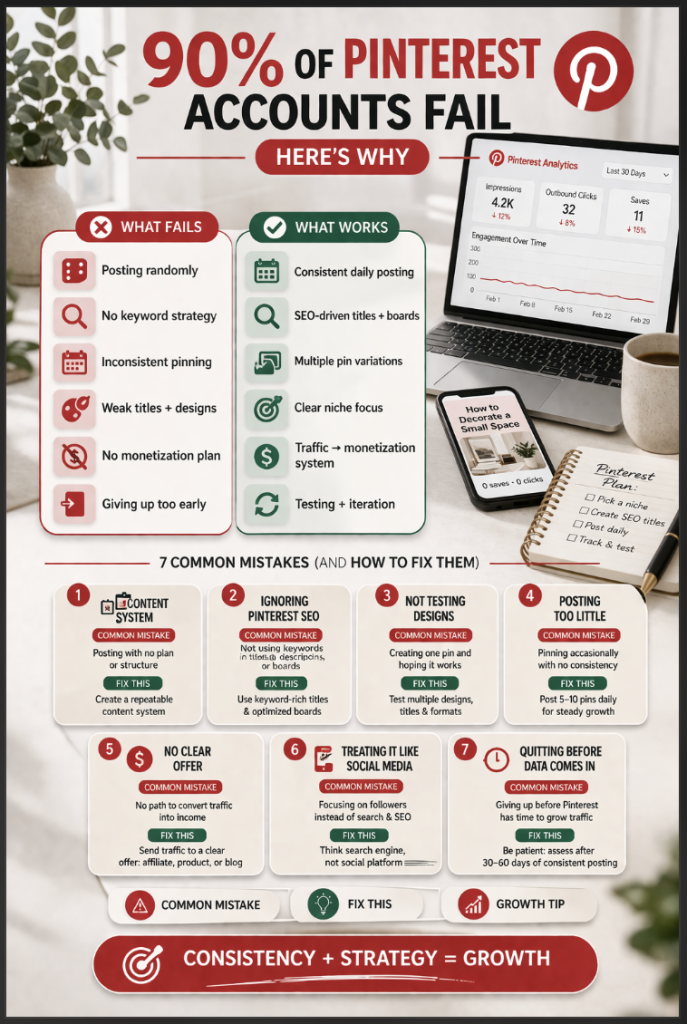
But why? Why do people struggle with Pinterest. It often has nothing to do with having the next content, the fanciest design software, or even cracking the latest algorithm update. After years of observing what separates successful accounts from the ones that stagnate, it comes down to five common, yet powerful, reasons.
If you’re struggling to grow your Pinterest account, or you’re just starting out, understanding these pitfalls is the first step to avoiding them.
1. You Quit Too Soon
This is the most common reason for failure, and it’s the most straightforward. You quit. Many aspiring creators get a burst of inspiration, create a beautiful profile, and start pinning with enthusiasm. But when they don’t see immediate results—when their follower count barely budges and their Pins get minimal engagement—discouragement sets in.
They don’t realize the sheer amount of work and patience required. Creating high-quality Pins, doing keyword research, engaging with the community, and staying consistent is a significant time investment. It can feel like you’re creating for an audience of zero for a long, long time. The temptation to give up is immense.
But here’s a simple mindset shift: quitting is the only way to guarantee you will never succeed. As long as you keep creating, keep learning, and keep showing up, you keep the door of possibility open. The moment you quit, you close that door forever.
Ready To Build A More Flexible Income Stream?
2. You’re Pinning for Yourself, Not Your Audience
Many new creators treat their Pinterest account like a personal mood board. They pin everything they’re interested in: recipes, then home decor, then business tips, then travel destinations, then fashion. The problem? You’ll be hard-pressed to find a single person who is equally interested in all of those disparate topics from the same account.
This doesn’t mean you need to box yourself into a tiny, restrictive niche. But you do need a unifying theme and a clear idea of who your audience is.
Instead of pinning about everything you love, find the intersection of what you enjoy and what a specific audience is looking for. If you’re a food blogger, your audience might be interested in your recipes, but also in kitchen organization tips or tablescape ideas. Those are adjacent interests. They are not, however, likely interested in your coding tutorials.
Before you create your next Pin, ask yourself: “Who is this for? What value does it provide to them?” A successful account is built on serving a defined audience, not just your own varied interests.
3. You’re Pinning Just to Pin
We’ve all heard that “consistency is key” on Pinterest. And it is. But this advice can be dangerous when misinterpreted. Many creators become so hyper-focused on a pinning schedule that they sacrifice quality and intention. They become a Pin factory, churning out low-effort content just to check a box on their to-do list.
This is the path to burnout and invisibility. The Pinterest algorithm, and more importantly, the real people using the platform, can spot low-value content from a mile away. Using generic templates without customization, writing lazy descriptions, and creating Pins that don’t offer real entertainment, education, or inspiration will not get you the results you want.
Instead of just trying to hit a quota, focus on creating content with intention. Every Pin should have a purpose. Ask yourself: “Would I stop my scroll to look at this? Would I click on this? Would I save this to one of my own boards?” If the answer is no, it’s not worth pinning.
4. You’re a Perfectionist
On the opposite end of the spectrum from the content factory is the perfectionist. This is the creator who spends hours agonizing over a single Pin. Is the font right? Is the photo perfect? Is the wording in the description absolutely flawless? They are so focused on quality that they fail to achieve the other crucial ingredient for success: quantity.
Perfectionism is often a mask for fear. Fear of judgment, fear of not being good enough, fear of putting yourself out there. It’s easier to say “it’s not ready yet” than to say “I’m scared to post this.”
Your first Pins won’t be your best. Your 100th Pin won’t be perfect either. The only way to get better at creating content is to practice. You need to publish your work, see what resonates with your audience, and iterate. You cannot improve in a vacuum.
Don’t wait until your Pins are perfect to start. Find the happy medium between quality and consistency. Create the best Pin you can today, post it, and then focus on making the next one even better.
5. You’re Stuck in a Follower Mentality
Many of us start on Pinterest as consumers. We follow our favorite creators, admire their beautiful feeds, and save their ideas. This is what inspires us to start our own accounts. But it can also become a trap.
When you’re stuck in a “follower mentality,” you see successful creators as being on a different level. You put them on a pedestal and see yourself as just a fan. This can hold you back from taking yourself seriously as a creator. You might feel like you don’t “deserve” brand deals, collaborations, or a large following of your own.
It’s time to embrace the fact that you are a creator, too. The people you admire are just people who started where you are and kept going. They are your peers, not untouchable celebrities.
It’s great to be inspired by others, but don’t let that admiration prevent you from seeing your own potential. You have a unique voice and value to offer. Own it.
The Path Forward
Avoiding these five pitfalls is the foundation of building a successful Pinterest presence. It requires a shift in mindset from being a passive consumer to a strategic creator. It’s about finding the balance between quality and consistency, serving an audience with intention, and having the persistence to keep going, even when the results aren’t immediate. Your dream of Pinterest success is possible, but it starts with avoiding the very things that cause most accounts to fail.